
- What is SEO Competitor Analysis
- Why Automated SEO Competitor Analysis Matters Now
- The Playbook: How to Build an Automated Competitor Monitoring System
- Step 1: Define Your Competitor Universe
- Step 2: Set Up Content Change Detection
- Step 3: Extract & Digest with LLM
- Step 4: Distribute Actionable Intelligence
- Case Study: 10x Faster Competitor Response with Automated Monitoring
- The Challenge
- The Solution
- The Results
- Get the Template: Plug-and-Play SEO Competitor Tracking Workflow
- Conclusion
Here's the uncomfortable truth about SEO competitor analysis: most marketers are still doing it by hand. Opening 10+ tabs every morning. Skimming headlines. Copy-pasting URLs into a spreadsheet that nobody looks at after Tuesday. Meanwhile, your competitors just published a piece targeting your #1 keyword, and you won't find out until it's already outranking you.
There's a better way. In this guide, we'll break down a complete playbook for automating your competitor content monitoring from setup to actionable intelligence delivery. And we're not just theorizing. We'll walk you through a real case study where we built a zero-touch competitor radar that:
- Cut manual monitoring time by 30–60 minutes per day
- Compressed response time from days to minutes
- Scaled from 12 competitors to 100+ without breaking a sweat
Let's get into it.
What is SEO Competitor Analysis
SEO competitor analysis is the process of systematically evaluating how rival websites perform in organic search—examining their keyword rankings, content strategies, backlink profiles, and technical optimizations—to identify gaps, opportunities, and threats that inform your own SEO strategy.
That's the textbook definition. But in practice, competitor analysis isn't one thing; it's three distinct disciplines stacked on top of each other:
The Three Layers of SEO Competitor Analysis
| Layer | What You're Tracking | Typical Tools | Update Frequency |
|---|---|---|---|
| Keyword Layer | Ranking positions, search volume, SERP features | Ahrefs, SEMrush, Moz | Weekly / Monthly |
| Content Layer | New articles, topic coverage, publishing cadence | Manual checks, RSS, crawlers | Daily / Real-time |
| Strategy Layer | Messaging shifts, campaign themes, audience pivots | Qualitative review | Quarterly |
Most SEO guides obsess over the keyword layer and for good reason. It's measurable, reportable, and easy to benchmark. But here's what they miss: keywords are lagging indicators. By the time a competitor's new article shows up in your rank tracker, it's already been indexed, started accumulating backlinks, and maybe even claimed a featured snippet.
The content layer is where the real leverage sits. If you can detect what competitors publish within hours instead of weeks, you gain:
- First-mover options on reactive content
- Early warning on new keyword targets
- Strategic signal on where their bets are shifting
This guide and the case study we'll walk through focus on automating the content layer: building a system that monitors competitor blogs in near real-time and delivers pre-digested intelligence to your team before anyone opens a spreadsheet.
Why Automated SEO Competitor Analysis Matters Now
Competitor analysis has always been important. But in 2026, it's no longer optional, it's existential. Three things have compressed the window between "awareness" and "irrelevance" to a matter of days, sometimes hours.
The AI Content Explosion Has Changed the Math
The generative AI content creation market was valued at $14.8 billion in 2024 and is projected to reach $80.1 billion by 2030—a compound annual growth rate of 32.5%, according to Grand View Research.
What does this mean for your competitive landscape? Your competitors aren't just publishing more; they're publishing faster, at scales that would have required entire content teams just two years ago. A single marketing manager armed with AI can now produce what used to take a 5-person team a full sprint.
The implication is brutal: the volume of content you need to monitor has exploded, but your team size hasn't.
First-Mover Windows Are Shrinking Fast
The truth about SEO in the AI era is: the first comprehensive answer often wins and keeps winning. Recent research from Xponent21 reveals just how dramatic the stakes have become:
- ~50% of Google searches now include an AI-generated overview at the top of results
- When an AI Overview appears, click-through rates on organic results drop from ~28% to just 11%
- 70% of users never scroll past the top third of an AI summary
- The top 50 domains captured nearly 30% of all AI overview citations
This isn't just about ranking anymore. It's about being cited as the authoritative source before your competitors even know the topic is trending. If a competitor publishes a definitive piece on a topic before you, they may lock in that AI citation advantage for months. By the time you notice their content in your rank tracker, it's already been indexed, cited, and entrenched.
Speed isn't a nice-to-have. It's the entire game.
The Hidden Cost of Manual Monitoring Is Staggering
Let's do the math on what "checking competitor sites manually" actually costs. Assume a marketing specialist spends 30–60 minutes per day scanning 10–15 competitor blogs:
| Daily Time | Monthly Hours | Annual Hours |
|---|---|---|
| 30 min | ~10 hours | ~120 hours |
| 60 min | ~20 hours | ~240 hours |
That's 1–2 full work weeks per year spent on a task that produces nothing but raw awareness, not analysis, not strategy, not action. And here's the real kicker: even with all that effort, manual checks miss things.
Meanwhile, Forbes Advisor reports that 72% of businesses have already adopted AI for at least one business function, with 64% believing AI will increase their productivity. The companies automating this grunt work aren't just saving time, they're reallocating human brainpower to strategy and execution.
The Playbook: How to Build an Automated Competitor Monitoring System
In this section, we'll show you exactly how to build an automated competitor content system that eliminates this latency entirely and how we did it ourselves. We've broken it into four sequential steps. By the end, you'll have a clear blueprint you can implement with off-the-shelf tool or hand to your ops team for execution.
System Architecture Overview
Before we dive into each step, here's the big picture:
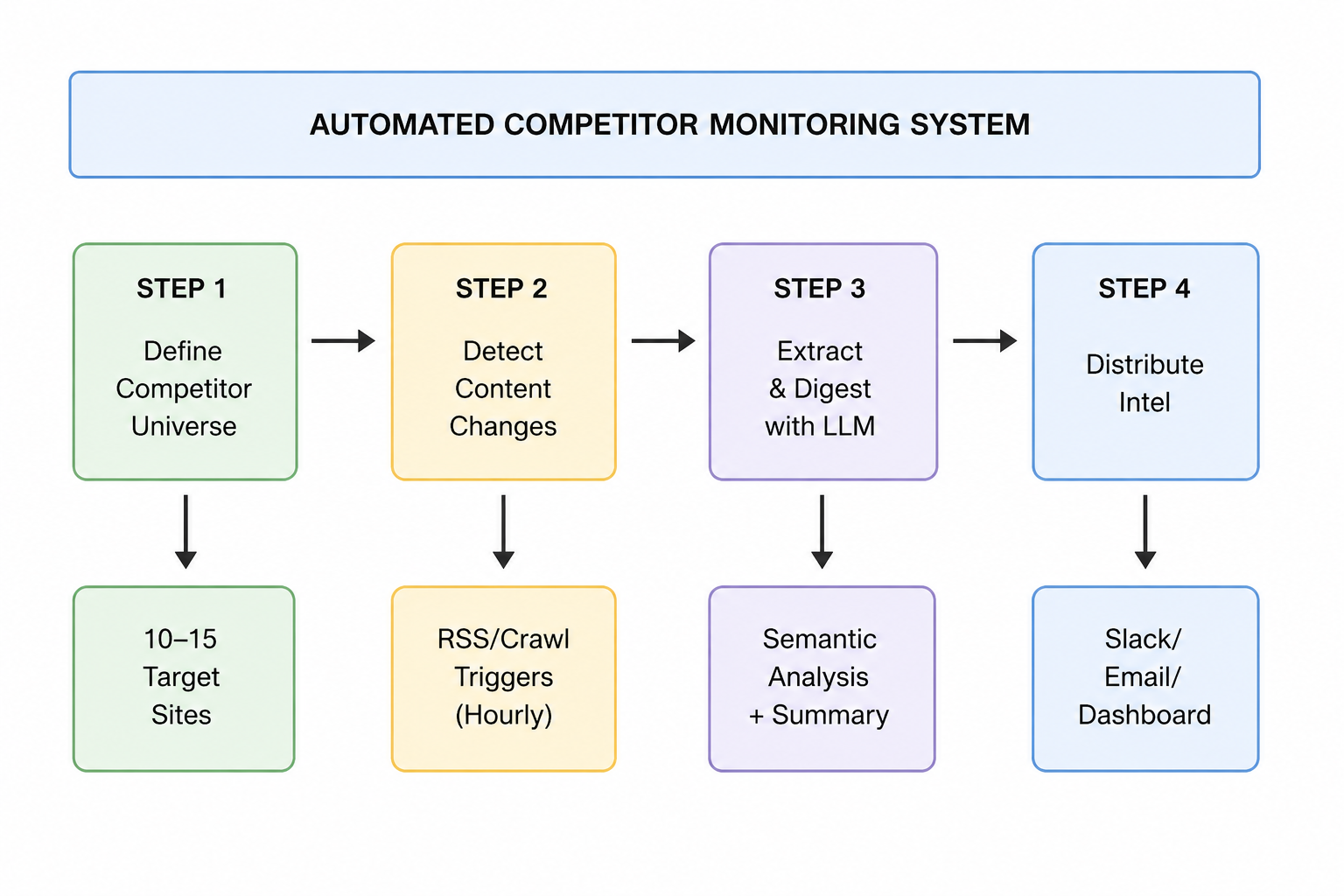
Now let's break down each component.
Step 1: Define Your Competitor Universe
Before you automate anything, you need clarity on who you're actually monitoring. This sounds obvious, but most teams skip this step and end up either drowning in noise or missing the signals that matter. Start by categorizing competitors into two buckets:
| Type | Definition | Why It Matters |
|---|---|---|
| Direct Competitors | Companies selling similar products to similar customers | Their content signals product positioning shifts |
| Content Competitors | Sites ranking for your target keywords but not selling competing products | Their content sets the bar for what Google considers "best answer" |
Your monitoring list should include both types. A SaaS company, for example, might monitor 5 direct competitors and 10 content competitors (industry blogs, media sites, adjacent tools).
Recommended Starting Point:
- 10–15 sites total for initial setup
- Bias toward competitors with active blogs (publishing 2+ articles/week)
- Include at least 2–3 "reach" competitors—bigger players whose moves signal market trends
Automation amplifies whatever you feed it. If your input list is noisy or incomplete, your output intelligence will be too. Spend an hour getting this right upfront; it saves dozens of hours in filtering garbage later.
Step 2: Set Up Content Change Detection
Now you need a mechanism to automatically detect when competitors publish new content. There are three main approaches, each with tradeoffs:
| Approach | Pros | Cons | Best For |
|---|---|---|---|
| RSS Feeds | Simple, reliable, low maintenance | Many sites don't have RSS; limited metadata | Blogs with active RSS |
| Custom Crawlers | Full control, works on any site | Requires dev resources; breaks when HTML changes | Teams with engineering support |
| Workflow Automation Tools | No-code setup; handles both detection + processing | Platform dependency; cost scales with volume | Marketing/ops teams without devs |
In our own implementation, we found that RSS left too many blind spots—roughly 40% of target sites had broken or missing feeds—and our custom crawler kept breaking whenever competitors redesigned their blogs. We ultimately went with a workflow automation tool to get the best of both worlds: broad coverage without the maintenance headache.
This approach and the exact workflow we built—is detailed in the case study below. If you'd rather skip the build entirely, there's also a ready-to-use template you can deploy in minutes.
Key Decision Points:
⏱️ Monitoring Frequency
- For most content marketing use cases, hourly checks strike the right balance
- More frequent = more API calls / compute cost; less frequent = longer detection latency
- Daily checks are acceptable for slower-publishing competitors
⚡ Trigger Conditions:
- Trigger on new URLs detected on blog / resource sections
- Optionally trigger on significant updates to existing pages (useful for pillar content)
- Avoid triggering on every page change, you'll drown in noise from minor edits
Detection is the foundation. If your system doesn't reliably catch new content, everything downstream is worthless. Invest in making this layer bulletproof and low-maintenance.
Step 3: Extract & Digest with LLM
This is where most competitor monitoring setups stop and where the real value begins. Once you detect a new competitor article, don't just pass along the URL. Extract the content and use an LLM to generate a structured intelligence brief.
Standard extraction pipeline:
- Fetch full page content (HTML → clean text)
- Pass to LLM with a structured prompt
- Output: summary, main topic, target keywords, marketing angle, key takeaways
Why Traditional Crawlers Aren't Enough
Classic web scrapers work by targeting specific HTML selectors. The problem? Modern websites are a moving target:
- Frequent redesigns break hardcoded selectors
- JavaScript-rendered content doesn't appear in raw HTML
- Dynamic layouts (A/B tests, personalization) serve different structures to different users
In contrast, LLMs provide semantic-level page understanding. They extract "what the article is about" rather than "what's inside <div class='content'>". This makes your system dramatically more robust to site changes.
Recommended Output Schema
Have your LLM return a structured JSON or Markdown brief:
{
  "competitor": "Competitor Name",
  "article_title": "How to Do X: Complete Guide",
  "url": "https://competitor.com/blog/...",
  "published_date": "2025-05-03",
  "summary": "2-3 sentence summary of main argument",
  "primary_topic": "Topic category",
  "target_keywords": ["keyword 1", "keyword 2"],
  "marketing_angle": "Product launch / Thought leadership / SEO play / etc.",
  "key_takeaways": ["Takeaway 1", "Takeaway 2"],
  "suggested_response": "Brief recommendation for your team"
}
This transforms raw content into pre-digested, actionable intelligence.
Step 4: Distribute Actionable Intelligence
The final step is getting the intelligence to the right people, in the right format, at the right time. This is where most DIY solutions fail. They technically work, but the output sits in a database or log file that nobody checks.
Distribution channel options:
| Channel | Best For | Considerations |
|---|---|---|
| Slack / Teams | Real-time alerts; small teams | Can get noisy; use dedicated channel |
| Email Digest | Daily/weekly summaries; async teams | Batching reduces interruption; harder to act immediately |
| Dashboard / Notion | Searchable archive; trend analysis | Requires someone to proactively check |
| Hybrid | Most teams | Real-time Slack + weekly email rollup works well |
From "Link Dump" to "Ready-to-Use Intel"
❌ Bad alert:
New competitor article detected:
https://competitor.com/blog/some-article-slug
✅ Good alert:
🚨 New from [Competitor Name]

"How to Automate Your Marketing Stack in 2026"

📌 Summary: Argues that manual marketing ops is dead;
   pitches their automation platform as the solution.

🎯 Target Keywords: marketing automation, martech stack
💡 Angle: Product-led SEO play

⚡ Suggested Response: Consider updating our automation
   guide to address the same pain points.

🔗 Read full article →
The difference between a useful alert and an ignored one is formatting and context.
The second version gives your team enough context to decide whether to act without clicking through. Automation without distribution is just logging. The goal isn't to collect data, it's to change team behavior. Make it effortless for your team to consume and act on competitive intelligence.
Case Study: 10x Faster Competitor Response with Automated Monitoring
Theory is easy. Execution is where most teams stall. In this section, we'll walk through exactly how we built and deployed an automated competitor monitoring system for our own content marketing operation. This isn't a hypothetical. It's a real workflow we use every day.
The Challenge
Our content team faced a problem that will sound painfully familiar. We were tracking 12 competitor blogs across our market—a mix of direct competitors and high-authority content players ranking for our target keywords. In theory, someone on the team was supposed to check each site daily for new publications. In practice? It was a mess.
The manual process was unsustainable. Scanning 12 blogs, skimming headlines, logging interesting finds—this ate up 30 to 60 minutes every morning. And that's assuming whoever was responsible actually did it. Sick days, busy weeks, and simple forgetfulness meant coverage was inconsistent at best.
FOMO was constant. We'd regularly discover that a competitor had published a major piece—targeting one of our core keywords—days after it went live. By then, it was already ranking, accumulating backlinks, and shaping the narrative we should have been leading.
The output was useless. Even when we did catch new content, what did we have? A URL. Maybe a headline. No context on what the article argued, which keywords it targeted, or whether it warranted a response. The "intelligence" required just as much work to process as finding it did.
Our scraping attempts kept breaking. We tried building a simple crawler to automate detection. It worked—for about two weeks. Then a competitor redesigned their blog template, our CSS selectors broke, and we were back to square one.
We needed a system that was reliable, zero-maintenance, and delivered actionable intelligence.
The Solution
We built a fully automated workflow using our visual automation platform, GoInsight.AI, with LLM-powered extraction at its core. Here's the high-level architecture:
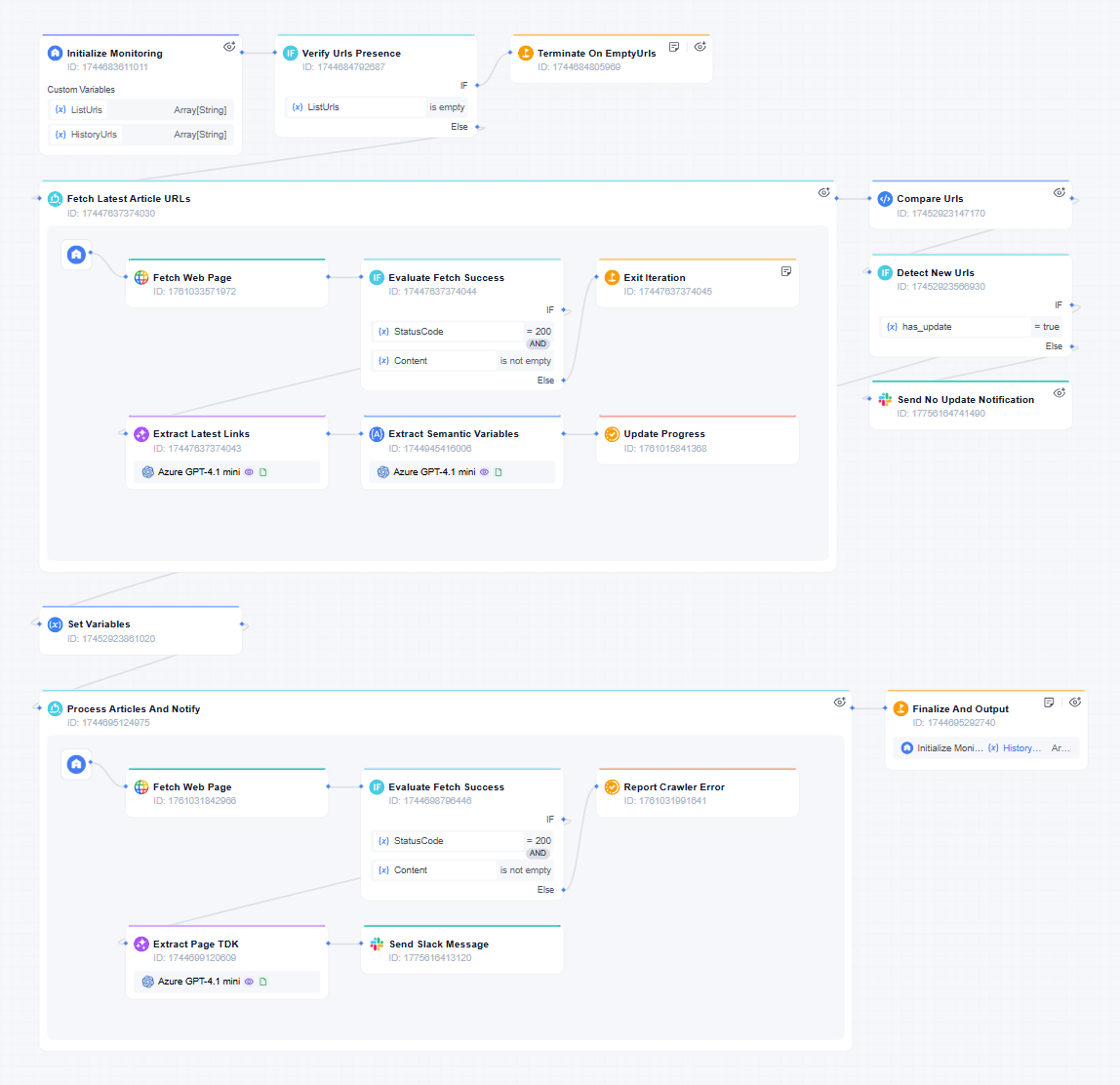
How the SEO competitor analysis system Works
- Initialize & Validate
- The system loads the competitor URL list and checks for empty inputs to avoid wasted runs.
- Fetch & Extract Latest Articles
- For each competitor site, the workflow fetches the blog page and uses an LLM to extract the latest article URLs. No brittle CSS selectors—the model semantically understands where the article links are, regardless of HTML structure.
- Compare & Detect New URLs
- Newly discovered URLs are compared against a stored history. Only genuinely new articles trigger downstream processing. If nothing's new, a "no update" notification fires to confirm the system is alive.
- Process & Notify
- For each new article, the workflow fetches the full page content, uses the LLM to extract the title, description, and key metadata, and then sends a formatted Slack message with a ready-to-act intelligence brief.
Key Design Decisions: The Nodes That Make It Work
1. LLM-Powered Universal Crawler Node:
This is the breakthrough that makes everything else possible. Instead of hardcoding CSS selectors or XPath rules, we use an LLM as a semantic crawler, instructing it in plain language: "Find all blog post links published today or yesterday."
2. URL Deduplication Logic Node:
New article detection is useless if you're re-alerting on content you've already seen. We built a lightweight deduplication step using set difference operations: list(current_urls - old_urls). This comparison runs in milliseconds, filtering out all previously detected URLs before any downstream processing. The result: zero noise from old content, and alerts only fire for genuinely new publications.
3. Persistent State Management Node:
The deduplication logic only works if the workflow remembers what it's seen before. We solved this with a self-updating stored variable (history_urls) that persists across runs. After each execution, newly discovered URLs are merged into the history set. This gives the workflow long-term memory—it knows its own detection history without external databases or manual state management.
The Results
After three months in production, the numbers speak for themselves:
Get the Template: Plug-and-Play SEO Competitor Tracking Workflow
You've seen the playbook. You've seen the results.
Now here's the shortcut: you don't have to build this from scratch.
We've packaged the exact workflow architecture from this case study into a ready-to-use template—the same system that cut our monitoring time to zero and compressed response latency from days to minutes.
Highly Transferable: Customize in Minutes
The core logic—fetch, extract with LLM, compare against history, distribute intelligence—stays the same. You just swap in your own sources and preferences:
| Component | What to Customize |
|---|---|
| Input URL list | Swap to your target competitor blogs or news sources |
| LLM extraction prompt | Adjust for the content type you're monitoring |
| Output channel | Slack, Email, Notion, or your team's preferred tool |
| Trigger frequency | Match to how fast your space moves (hourly, daily, etc.) |
Whether you're monitoring 5 competitors or 50, the template scales with you and you'll never hand-check a competitor blog again.
How to Deploy
- Import the template into your workspace
- Customize the four components above for your needs
- Run — and never hand-check a source manually again
No coding. No brittle scripts. No maintenance.
Conclusion
SEO competitor analysis isn't about checking boxes; it's about speed, signal, and strategic response.
In a world where:
- AI-generated content is flooding every niche at 32%+ annual growth
- First-to-publish advantages are compounding and self-reinforcing
- Manual monitoring burns 10–20 hours/month while still missing critical signals
Automation isn't a luxury. It's a survival skill. The playbook works. The results are measurable. And if you want to shortcut the implementation, the template is ready. Your competitors are publishing right now. The only question is: how long until you find out?





Leave a Reply.