
- How Deep Does AI Run in Customer Support
- Where AI Data Security Fails in Customer Support
- Why Traditional Governance Fails
- What Needs to Be Controlled
- Who Owns AI Data Governance
- How to Implement AI Data Governance in Customer Support Systems
- Input control: Establish data control at the entry point
- Process control: define and constrain AI decision-making
- Output control: govern what AI is allowed to generate
- Action control: Connect controls across the workflow
- Audit control: Enable continuous audit and loop
- Build Trustworthy Support Ticketing Systems with GoInsight.AI
- FAQs
Key Takeaways
- Nowadays, AI data governance is a real-time system control, not a static compliance checklist.
- Security must cover the entire pipeline from data intake and AI reasoning to automated actions and audits.
- AI failures are rarely isolated. True customer data protection requires monitoring how data, decisions, and actions interact.
- AI data governance Implementation requires a unified model of control + ownership + enforcement across the AI customer support workflow.
In the past, companies mainly judged AI in customer support by asking, "Can it answer customer questions?" Today, that question is outdated.
Modern customer support is no longer driven by standalone chatbots but powered by AI embedded into ticketing systems. AI does not just generates responses. It operates as an execution layer across the entire ticket lifecycle—automating intake, prioritization, routing, resolution, and even system actions.
As AI becomes deeply integrated into ticketing workflows, traditional governance methods like compliance checklists, static data rules, or access controls are no longer sufficient.
In this article, we'll explore where AI creates data risks within ticketing systems, and how to implement AI data governance across the full customer support workflow.
How Deep Does AI Run in Customer Support
AI has been widely used as chatbots for customer support, but nowadays, it goes beyond a single "chatbot" layer and spans diverse stages of the entire lifecycle. To understand what risks AI may create, we need a mental model of where AI actually operates first.
Ticket intake and data capture
Ticket intake is the entry point of customer support. At that point, AI acts as the "translator" to turn unstructured customer information into structured data that can be processed by systems. In most cases, AI handles tasks like intent extraction, auto-tagging with category and priority, and sentiment detection.
From a systems perspective, the accuracy of ticket intake determines routing quality, response speed, and resolution efficiency, and AI can contribute to it with no doubt. According to a case study, a platform has achieved over 95% routing accuracy through AI-based methods and reduced resolution times by nearly a third.
Automated response and self-service resolution
This is the most visible layer of AI adoption in customer support, as well as the most well-known field. AI is leveraged to interact directly with customers to provide 24/7 support. It relies on AI's capabilities of instant query resolution, multi-turn troubleshooting, and knowledge base retrieval.
While traditional self-service tools often struggle to resolve more than 15% of issues, AI-powered agents are now achieving 50-70% resolution rates for standard queries without human intervention.
Ticket classification and prioritization
This is the decision engine of your support workflow. Once a ticket is created, AI confidently takes over operational triage at a scale no human team can match. Its unmatched strength in priority assignment, sentiment-driven escalation, and topic clustering drives resolution speed and elevates customer experience.
Some academic research has indicated that AI-driven triage could reduce overall resolution time by 10% at least without sacrificing customer satisfaction.
Routing and escalation
Beyond initial classification, AI also plays an important role in making tickets move to the right place and escalate at the right time throughout their lifecycle. It can route tickets based on skills, balance workload, and detect SLA-risk for re-routing tickets.
Thus, AI transforms routing from a one-time decision to a continuous orchestration solution. Many cases have reported that AI adoption helps reduce manual intervention and downstream delays.
Where AI Data Security Fails in Customer Support
AI data security risks in customer support do not originate from a single vulnerability. As it is handling customer data all the time, especially in ticketing systems, the architectural reality introduces a new class of risks among systems, which are not abstract but break down across four layers, with a fifth layer of audit that determines whether these risks can be detected and controlled.
Data risk: data minimization failure
Data minimization is one of the core compliance principles of GDPR. Research shows that a lack of data minimization has been a common root cause of GDPR violations, especially in AI-powered systems. That's because AI systems highly rely on large volumes of data, which directly conflicts with data minimization.
In terms of ticketing, most AI systems are designed to capture as much as possible at the intake stage to improve accuracy. The collected data can contain information like Personally Identifiable Information (PII), financial data, account identifies, or other sensitive context. If developers and teams lack clarity on what data is actually required versus collected, the systems may ingest and retain more data than necessary. The uncontrolled intake will make everything downstream inherits the risk of GDPR violations because of data minimization failure.
Tips: What is GDPR and Data Minimization?
- The General Data Protection Regulation (GDPR) is the European Union's core data protection law that governs how organizations collect, process, and store personal data.
- Data minimization is a core GDPR principle that requires organizations to collect and process only the data that is necessary for a specific purpose.
Process risk: uncontrolled data flow
Once data is captured, customer data flows through multiple components that might include, but are not limited to, NLP models for classification, LLMs for response generation, routing systems, third-party APIs, and SaaS integrations. When data is transferred across systems without consistent governance, a distributed and often opaque data pipeline brings more risks, such as external service providers may process or store data outside your control, while cross-border data transfer risks increase significantly.
Gartner highlights that organizations struggle to enforce privacy and data protection policies in externally hosted AI environments, especially with third-party models. Many of them lack visibility into how AI ticketing systems handle customer data at runtime, which leads to compliance exposure. Fundamentally, this is a data lineage problem because you cannot secure what you cannot trace.
Output risk: data leakage through AI outputs
In traditional ticketing systems, data risk is mostly about storage. In an AI-powered one, risk also exists at the output layer. While generating responses using AI, you might face risks such as:
- AI unintentionally exposes sensitive data.
- Context from previous interactions "bleeds" into responses.
- Models reconstruct or infer private information.
AI security testing frameworks have explicitly identified data leakage through model outputs as a core risk category. And the non-deterministic behaviors of generative systems definitely make leakage harder to predict and detect.
Action risk: unauthorized or unsafe execution
Modern AI systems in customer support do not just suggest actions but increasingly execute them. For example, it can issue refunds, update account information, interact with backend systems via APIs, etc. At this point, the risk is about system behavior.
Recent industry analysis indicates that AI systems are now directly connected to business-critical operations and can trigger workflows across core systems, significantly expanding the risk surface.
Audit risk: lack of visibility and auditability
- Why was a ticket routed to a specific team?
- Why was a response generated in such a certain way?
- What data was used to make that decision?
In many cases, organizations found themselves unable to fully answer these easy questions because many AI ticketing systems still operate as black-box decision engines nowadays.
Without visibility, organizations cannot perform audits, investigate incidents, and demonstrate compliance to meet the regulations that increasingly require explainability, audit trails, and accountability.
Meanwhile, studies show that existing AI governance frameworks still leave up to 80% of high-risk compliance concerns insufficiently addressed. Therefore, AI risk is not just a technical one, but can be a governance failure as well.
Why Traditional Governance Fails
When AI operates across the entire customer support workflow and processes customer data across multiple systems and the decision layer, the question is no longer whether risks exist, but whether existing governance approaches are sufficient.
Talking about AI and data governance, we need to begin with what traditional governance actually does and what it was designed for.
What traditional governance actually covers
In most enterprises, "governance" historically refers to data governance frameworks built around structured data systems, such as CRM, data warehouses, and reporting systems. These frameworks typically include:
| Practice | Goal |
|---|---|
| Access control & permissions | Define who can access what data |
| Data classification & protection | Label sensitive data like PII and financial data |
| Data quality management | Ensure data accuracy, consistency, and completeness |
| Data lineage & cataloging | Track where data comes from and how it flows |
| Compliance & audit processes | Ensure alignment with GDPR, CCPA, and other regulations |
It's not hard to see that traditional governance operates mostly as a top-down control model that is often led by IT or data teams, and focuses on polices, roles, and defined processes that fit for stable and predictable data flows. That holds true for databases, dashboards, and analytics pipelines.
When AI ability is leveraged on customer support systems, the gap begins. In AI-powered customer support systems:
- Data is not just stored but interpreted.
- Data is not just queried but transformed and recombined.
- Systems do not just retrieve but generate and act.
At that point, AI breaks traditional governance assumptions, which leads directly to the fact that traditional governance is not enough in diverse aspects.
Risk becomes systemic, not localized
In traditional systems, risk is isolated at specific points (e.g., securing a database). You can use data lineage to track a predictable path from source to destination.
The AI Gap: In AI-driven support, data is continuously reinterpreted and enriched across multiple stages. Risk isn't tied to a single entry point; it's distributed across the entire workflow. By the time a failure surfaces, the "original" point of failure is often invisible, making traditional lineage insufficient.
AI systems act on data, not just store it
Traditional governance assumes systems are passive: they store, retrieve, and present data. Policies focus on "Who can access the data?"
The AI Gap: AI is an active operator. It autonomously classifies tickets, interprets sentiment, and triggers actions. The governance question shifts from access to accountability: "What decisions can the system make, and what happens when they are wrong?" Traditional tools aren't built to govern system behavior.
Visibility breaks down in AI systems
Old-school compliance relies on deterministic logging (Action A leads to Result B).
The AI Gap: AI outputs are probabilistic. Two similar customer queries might yield different outcomes based on model state or context. This creates "invisible failures" where errors that exist in the output but don't show up in a standard error log. Without deeper observability into AI reasoning, compliance becomes impossible to demonstrate.
Compliance becomes behavior-dependent
Historically, compliance was a static property of how data was stored or retained.
The AI Gap: In an AI workflow, compliance is a dynamic property of system behavior. Because the same data can lead to different outcomes depending on the AI's interpretation, you can no longer prove compliance just by showing who accessed a file. You must prove the integrity of the AI's behavior in real-time.
What Needs to Be Controlled in Customer Support
As we've seen in the previous sections, demand for data governance for AI increases in modern customer support systems. While adopting AI into customer support, you must answer one foundational question: Does your AI operate within defined, controllable, and auditable boundaries?
Data: what enters and flows through the system
Data remains the foundation of AI governance. As industry guidance emphasizes, AI governance builds on data governance by ensuring not just data quality and access, but also how data is used across the full lifecycle. Without this, every downstream layer inherits risk.
Quick Check: Is your data in AI systems actually governed?
- Do you clearly define what customer data should (and should not) be captured at intake?
- Do you know which systems or models process this data (including third-party tools)?
- Can you trace how customer data flows across your support workflow?
- Do you have controls to prevent sensitive data from being unnecessarily stored or reused?
If you find yourself answering "no" or "not sure" multiple times, your risk starts at the very first step and might propagate forward.
Decision: how AI makes choices
Decision refers to internal reasoning before any generation or execution. If data is the input layer, decision-making is the core of AI behavior. Decisions made by AI are probabilistic, context-dependent, and variable across similar inputs. Governance must define what decisions AI is allowed to make, and under what conditions, to ensure decisions are interpretable, accountable, and justifiable.
Quick Check: Are decisions made by AI under control?
- Do you define which decisions AI is allowed to make autonomously?
- Are there thresholds (e.g., confidence, risk level) that determine when human intervention is required?
- Can you explain why a ticket was routed, prioritized, or responded to in a certain way?
- Are decision outcomes consistent across similar inputs?
If you find yourself answering "no," the AI behavior of your system will become unpredictable, even if your data is secure.
Output: what AI generates
Output refers to all AI-generated content, including responses, summaries, classifications, or structured results before any system action is triggered. This layer introduces risks such as hallucinations, sensitive data leakage, or policy-violating responses.
Quick Check: Is AI output governed?
- Are response boundaries and sensitive data rules clearly defined?
- Do you monitor outputs for hallucinations or leakage?
- Are guardrails (PII masking, grounding, filtering) enforced before delivery?
- Do you log generated outputs with context and policy attribution?
Action: what AI is allowed to do
Nowadays, AI systems increasingly go beyond decision-making into action execution. For example, in customer support, this includes API calls, system updates, refunds, routing triggers, or any write operation. Risks at this layer are not just technical but also operational.
Quick Check: Do You Control What AI Is Allowed to Execute?
- Can AI systems trigger actions (e.g., refunds, escalations, updates) without restriction?
- Do you define which actions require approval vs. full automation?
- Is there a fallback mechanism if an AI-triggered action is incorrect?
- Can you override or stop AI actions in real time?
Audit: how the system is verified and proven
Finally, we reach the audit layer. Similar to traditional governance, AI governance is incomplete without auditability. If you cannot prove system behavior, governance effectively does not exist. But in traditional systems, logs are often sufficient, while AI systems require something more.
Quick Check: Can You Prove Your System's Behavior?
- Can you reconstruct a full chain from input → decision → action for any ticket?
- Do you log decision context, not just outcomes?
- Can you demonstrate that policies were enforced at runtime?
- Are you able to support compliance audits or incident investigations?
Cross-layer control (system integrity layer)
Rather than being a separate control layer, workflow governance emerges from the integration of all preceding layers. In AI-powered customer support systems, risks rarely occur within a single step. Instead, failures emerge from interactions between data ingestion, decision logic, output generation, and execution behavior.
Quick Check: Is your AI workflow governed end-to-end?
- Can you trace a ticket from input → decision → output → action?
- Can you detect where a failure occurred across the pipeline?
- Are guardrails enforced between each control boundary?
- Do you monitor system behavior holistically, not in isolation?
Who Owns AI Data Governance
Unlike traditional governance, ownership of data governance in AI is not centralized. Instead, it is embedded into each layer of the system and distributed across teams responsible for different parts of the AI lifecycle. Without clear ownership, governance becomes a documentation exercise rather than an operational system.
| Control Layer | Primary Owner | Core Responsibilities |
|---|---|---|
| Data Layer | Data / Platform Team | Owns data ingestion pipelines
|
| Decision Layer | AI / Product Team | Owns classification logic
|
| Output Layer | AI + Compliance Teams | Ensures AI-generated responses are safe, grounded, and compliant with privacy and policy requirements. |
| Action Layer | Engineering + Security Teams | Owns execution boundaries
|
| Audit Layer | Risk / Compliance Teams | Owns traceability, logging standards, explainability, and regulatory reporting requirements. |
Ownership alone does not define governance. It becomes meaningful only when it is directly embedded into system-level enforcement across the AI workflow.
How to Implement AI Data Governance in Customer Support Systems
Once control surfaces and ownership are defined, data governance for AI must be operationalized as enforceable system behavior across the full workflow. A recent industry guidance suggests that governance today must include real-time visibility, enforcement, and auditability across AI interactions.
The step-by-step guide below shows how to implement AI governance in customer support with four pillars of control, visibility, enforcement, and audit.
Input control: Establish data control at the entry point
AI governance begins where data enters your system. Step 1 is to make AI only process authorized and cleaned data and ensure data minimization policy.
| Pillar | Implementation action |
|---|---|
| Control | Filter unauthorized data fields from incoming tickets. |
| Visibility | Map the flow of customer data from the CRM to the AI model. |
| Enforcement | Mask PII in real-time before AI processing begins. |
| Audit | Log data filtering events for GDPR/SOC2 compliance. |
Process control: define and constrain AI decision-making
Once data is controlled, AI will take part in making decisions, such as which agent should handle which customer ticket, how urgent the issue is, or whether the customer is frustrated. This step is to introduce boundaries to the internal reasoning layer, making decisions accurate and accountable.
| Pillar | Implementation action |
|---|---|
| Control | Set boundaries for AI ticketing authority (e.g., triage only). |
| Visibility | Expose logic for ticket categorization, routing, and sentiment analysis. |
| Enforcement | Block biased, toxic, or hallucinated resolution suggestions. |
| Audit | Log why a ticket was routed or escalated by AI. |
Output control: govern what AI is allowed to generate
Output refers to all AI-generated content, including responses, summaries, classifications, or structured results. Output does not itself trigger system-level changes. But an AI system may produce responses that expose sensitive data, hallucinate incorrect information, or violate compliance requirements. Output control is to ensure that what AI generates is safe, compliant, and contextually grounded before it reaches the customer.
| Pillar | Implementation action |
|---|---|
| Control | Define policies for sensitive data exposure and response boundaries. |
| Visibility | Monitor generated outputs for anomalies, hallucination, or leakage. |
| Enforcement | Apply guardrails (e.g., content filtering and grounding checks). |
| Audit | Log generated responses along with context and applied policies |
Action control: Connect controls across the workflow
Once AI moves beyond generating responses and starts executing actions, governance must enforce strict control at the execution boundary.
| Pillar | Implementation action |
|---|---|
| Control | Restrict AI access to APIs and system capabilities (least privilege). |
| Visibility | Monitor all tool usage and external system interactions. |
| Enforcement | Intercept and block unsafe or unauthorized actions in real time. |
| Audit | Log every executed action with context, authority, and outcome. |
Audit Control: Enable continuous audit and loop
Finally, governance must prove its value. You need to track not just safety, but the actual cost-to-resolution and ROI of your AI agents.
| Pillar | Implementation action |
|---|---|
| Control | Set budget/token limits per ticket or support tier. |
| Visibility | Measure ticket resolution efficiency vs. AI spend. |
| Enforcement | Ensure all operations pass through logging points. |
| Audit | Enable traceability and compliance validation |
Build Trustworthy Support Ticketing Systems with GoInsight.AI
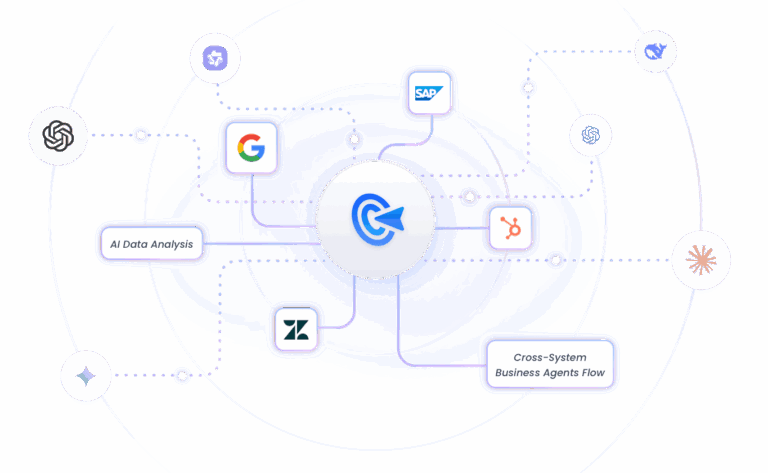
After having a clear understanding of data governance in AI customer support systems, it's time to set up a secure and audit-ready automation solution for support ticketing using GoInsight.AI.
You can build, deploy, and manage intelligent agents for critical tasks, such as ticketing routing and SLA breaches. And the security and compliance features of GoInsight.AI will ensure governed AI operations for your business.
Key Security and Compliance Abilities
- End-to-End Data & Model Control: Isolate proprietary data from training loops and secure the full inference lifecycle with strict controls.
- Granular Access & Zero-Trust Governance: Enforce identity-based, real-time authorization for every AI interaction and system action.
- Auditability & Continuous Monitoring: Maintain immutable audit trails and full traceability for compliance, incident investigation, and regulatory defense.
FAQs
Ready to tackle manual ticket bottleneck?
See how GoInsight.AI enables teams to build AI automation workflows without needing complex technical skills.





Leave a Reply.