
- The Hidden Cost of Context-Blind Routing
- Do You Have a VIP Blind Spot?
- A High-Stakes Example: The Renewal Window
- Real-World Proof: Two Missing Signals, Two Useful Approaches
- What Happens When You Combine CRM Data and AI?
- A Reality Check: What This Approach Can and Cannot Do
- One Practical Way to Implement This Model: GoInsight.AI
- FAQs
- Traditional ticket routing creates a VIP blind spot: it sorts issues by category but ignores CRM context, leaving high-value accounts stuck in standard queues.
- The most effective solution layers two data sources: CRM signals (ARR, renewal dates, etc.) to identify which customers matter, and AI intent detection (gauging urgency and frustration) to assess why an issue is critical.
- Together, these signals turn standard helpdesk routing into an active retention strategy: automatically routing high-risk VIP tickets to senior specialists and alerting Customer Success before a renewal is at risk.
A $120k ARR customer submits a ticket:
"Our CRM-to-ERP integration has been failing nightly for two weeks. This is the third time we've reported it. We need a permanent fix before we discuss renewal."
Your routing system sees "integration issue" and sends it to the general queue. Normal priority. Standard SLA.
The rule works exactly as designed. But it cannot see what the CRM already knows: this is a high-value account, the renewal is close, and the health score is dropping.
That's the blind spot in many ticket routing systems. They can classify the ticket, but not the customer context behind it.
And when that context is missing, a routine support ticket can quietly become a retention risk.
The Hidden Cost of Context-Blind Routing
Basic smart routing does what it's designed to: distribute tickets, reduce workloads, and ensure nothing falls through the cracks. But many routing systems have a limitation: they tend to prioritize operational signals over customer value signals. That means the system may recognize:
- ticket category
- language
- channel
- SLA tier
- agent availability
But it may still miss the broader business context behind the request:
- contract value
- renewal proximity
- account health decline
- repeated unresolved issues
- customer history across support and success teams
This is what I would call the VIP Blind Spot: the system sees the issue, but not the importance of the customer behind it. When routing decisions lack that context, the result is rarely a dramatic technical failure. Typically, the problem lies in some more subtle yet more dangerous situations:
- high-value tickets are under-prioritized
- critical requests enter standard queues
- reassignments and delays increase
- frustration builds before renewal teams notice it
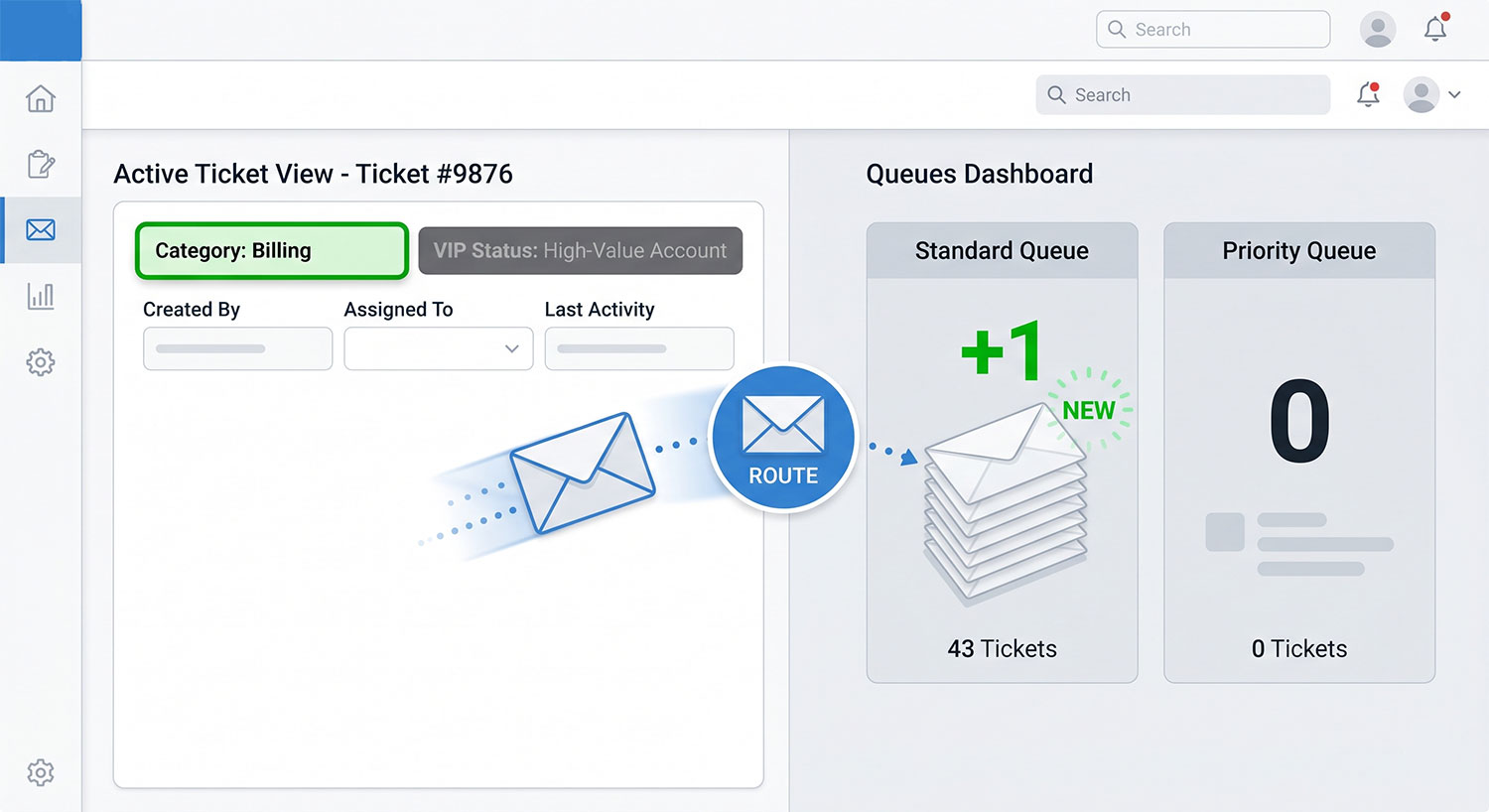
According to HubSpot's 2024 State of Service report, 82% of customers expect immediate resolution. Zendesk's CX Trends 2020 has also shown that long wait times remain one of the most frustrating parts of service.
For lower-value tickets, delay is mostly an efficiency problem. For high-value accounts near renewal, delay can become a retention problem. That distinction matters.
Do You Have a VIP Blind Spot?
Many teams assume their routing setup is "good enough" until a key account escalates or churns.
Use the questions below as a quick diagnostic:
1. Before a renewal conversation, can your customer success team see the support tickets that account submitted in the last 90 days? Or are those insights buried in a separate system?
2. Does high-value customers automatically receive different routing logic, or do they enter the same queue as everyone else?
3. When a ticket is initially misrouted, how often does it get reassigned before the right team takes ownership?
4. If a VIP customer writes "this is the fourth time" or "we need this fixed before renewal," does your system detect and escalate that language automatically?
5. Do your CSAT or CES scores look healthy, yet you still see unexpected churn, especially among your larger customers?
6. Have you ever discovered support frustration only after a renewal was already at risk?
If you answered "no" or "I'm not sure" to two or more of these, your routing system likely has a serious VIP Blind Spot. But you're not alone. And more importantly, it's fixable.
A High-Stakes Example: The Renewal Window
Not every support moment carries the same business risk. The period leading up to renewal is different. During that window, customers are not only evaluating product performance. They are evaluating responsiveness, trust, and whether your team feels coordinated when issues matter most. That is why a ticket that looks routine in the helpdesk can carry outsized commercial risk in the CRM.
The structural problem is familiar:
- support teams work in the helpdesk
- customer success teams work in the CRM
- account context and ticket context are often disconnected
As a result, tickets may be resolved too slowly, escalated too late, or discussed in isolation, while the renewal owner still assumes the account is healthy.
A real-world example comes from Creditsafe. Their challenge was not simply ticket volume. It was fragmented visibility across systems and teams. Support and technical teams could not easily see one another's work, and account-facing teams lacked a clear view of unresolved customer issues during critical moments. That kind of disconnect is what turns a support issue into a renewal surprise.
So the problem is not just slow support. It is missing context at the exact moment when context matters most.
Real-World Proof: Two Missing Signals, Two Useful Approaches
Public case studies on fully combined CRM + AI routing are still limited. But there is already strong evidence that the two underlying signals: customer value context and real-time issue intent, both improve support prioritization when used well. The examples below matter because they validate those two dimensions separately.
Case A: CRM-Driven Routing for High-Value Account
SysGroup's Zoho Desk case study shows how CRM-connected support workflows can help teams prioritize more important customers more effectively.
The situation:
SysGroup handled 2,000–3,000 support tickets monthly, split between automated alerts and customer-submitted requests. High-value customer issues could easily be buried under routine noise.What changed:
- Zoho Desk was implemented with CRM integration
- high-value customer tickets could bypass standard queues
- account context became more visible to support operations
- AI-powered capabilities such as sentiment analysis and automated task creation supported faster handling and follow-up
Takeaway:
CRM-driven routing ensures your most valuable customers are prioritized and never lost in the queue. This is evidence that routing improves when customer context is part of the decision.Case B: AI-Driven Routing for Urgency and Scale
Freshworks' Total Expert case study shows the value of AI-assisted routing in a high-volume support environment.
The situation:
Total Expert's support teams were handling heavy ticket volumes with outdated processes, response times stretched beyond seven days, and urgent or premium requests were difficult to separate quickly.What changed:
- Freshdesk introduced AI-powered routing and automation
- tickets were assigned based on team fit and urgency
- low-priority requests were handled by bots
- premium and enterprise customers were routed more quickly to live agents
Takeaway:
AI-driven routing delivers strong ROI, improving speed, scalability, and resource allocation, and comes with measurable results like +23% bot resolution, over 1,000 agent hours saved, and 248% ROI. This shows that AI improves routing when intent, urgency, and workload signals need to be processed at scale.What These Cases Actually Prove?
These examples do not prove that every team already runs a perfect combined routing model. What they do show is something more useful: customer-value signals and intent signals both improve routing quality, and they solve different parts of the prioritization problem. That leads directly to the next question: what happens when you combine them into a single routing decision layer?
What Happens When You Combine CRM Data and AI?
CRM-driven routing and AI-powered routing each improve prioritization, but in different ways. Used separately, each has limits:
- CRM data can tell you the account is important, but not whether the current message is truly urgent.
- AI intent detection can recognize urgency, escalation language, but it cannot judge the commercial importance of account on its own.
Used together, they create a much stronger routing signal.
The Two Layers of Context
A more context-aware routing model evaluates incoming tickets using two forms of intelligence:
- Customer context from the CRM: ARR, plan tier, renewal date, health score, open opportunities, recent account activity
- Issue context from AI analysis: urgency, repeated complaints, escalation language, sentiment shift, failure recurrence
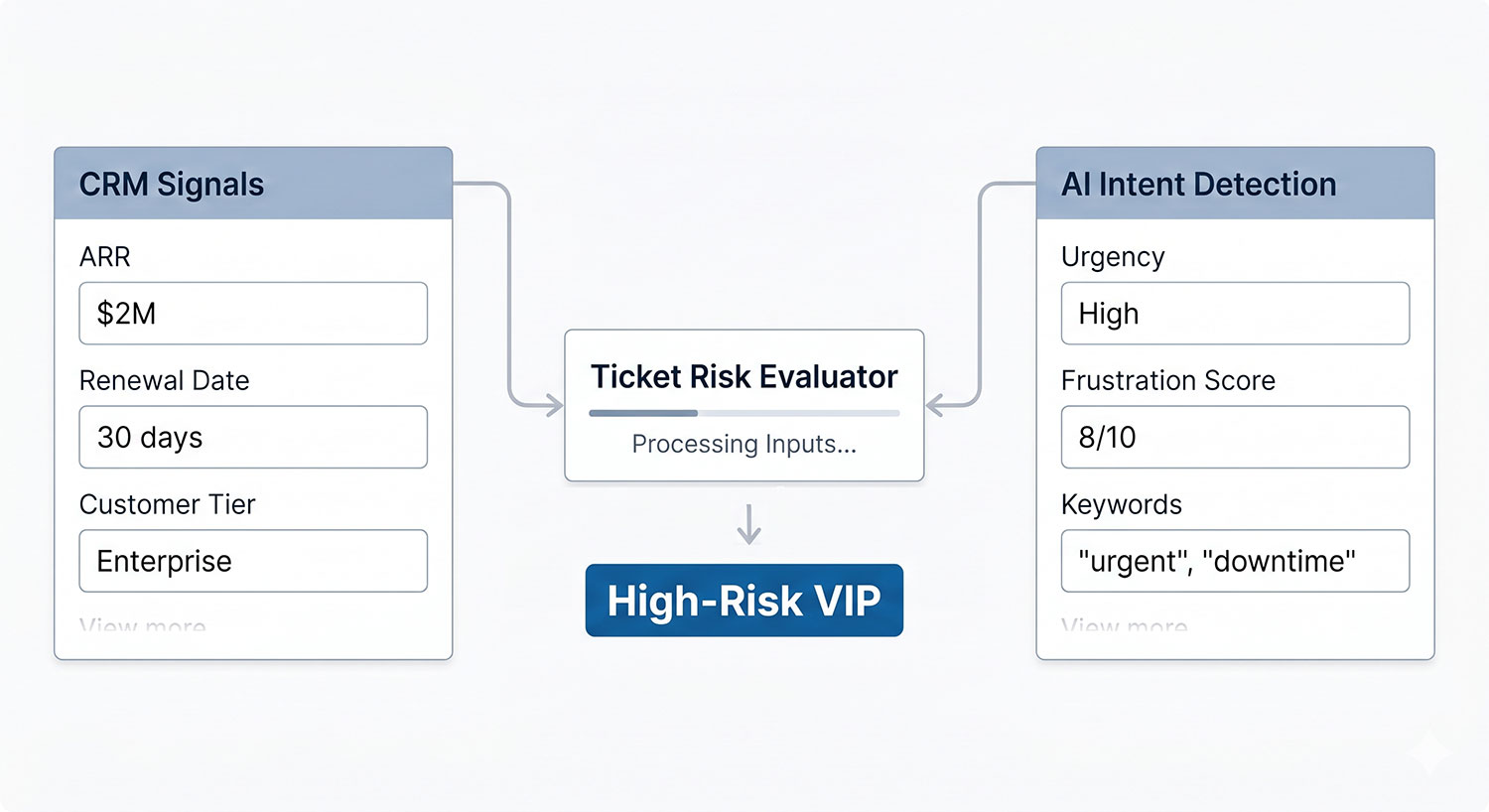
CRM tells you who matters most in business terms. AI helps interpret why this specific ticket may need immediate attention. That does not guarantee perfect routing. But it significantly improves the odds that high-risk, high-value tickets are recognized early instead of treated as routine queue traffic.
A Practical Example
Imagine a customer with:
- ARR above $100k
- renewal in less than 30 days
- declining account health
- a ticket containing phrases like "fourth time," "escalate now," or "fix this before renewal"
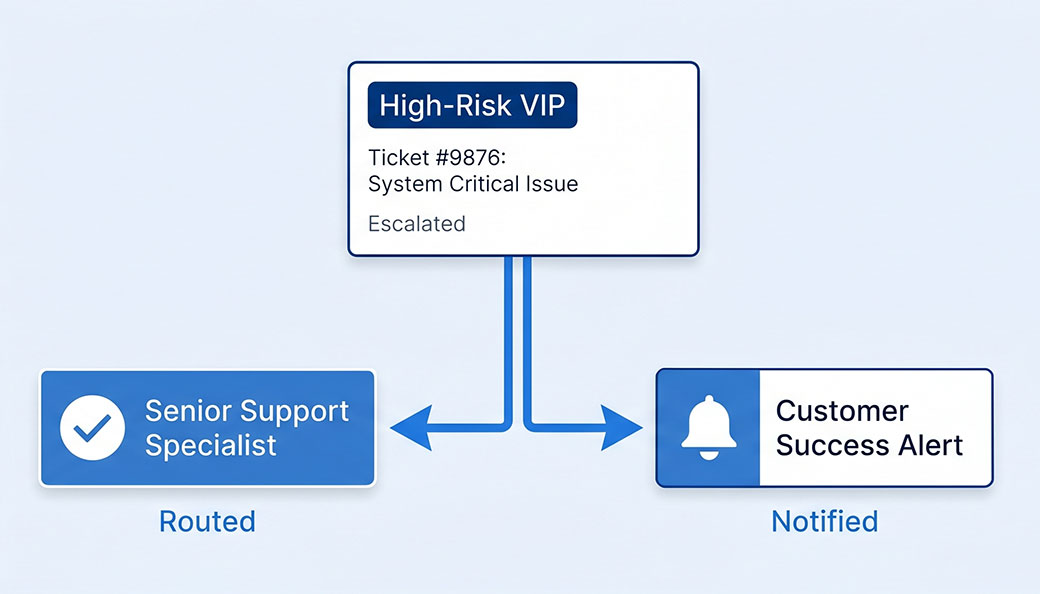
A context-aware routing model can treat that combination differently from a standard product question. It can automatically:
- assign higher priority
- route the issue to a senior specialist
- notify the customer success manager
- trigger an escalation workflow
That is the real advantage of combining CRM data and AI: it helps teams prioritize based on both operational urgency and customer value.
A Reality Check: What This Approach Can and Cannot Do
It is worth being precise here. You will not find many public case studies that show a fully integrated CRM + AI + routing model tied directly to retention outcomes. In many organizations, that level of workflow design becomes a competitive advantage and is rarely documented in full. So the case for this approach rests on a combination of:
- strong logic
- adjacent case study evidence
- established best practices in routing, CRM visibility, and AI-assisted prioritization
That also means this approach has limits. It will be less effective when:
- CRM data is outdated or incomplete
- account health scores are unreliable
- VIP criteria are too broad
- too many tickets are escalated, weakening the signal
- support and customer success teams lack clear ownership
Context-aware routing is not magic. It works best when the underlying customer data, routing rules, and team workflows are already reasonably healthy. That said, when those foundations are in place, combining CRM and AI signals can materially improve how teams identify and act on high-risk support moments.
One Practical Way to Implement This Model: GoInsight.AI
A team could build this routing layer internally. That means connecting CRM and helpdesk systems by API, defining business rules around renewal risk, passing ticket text through an LLM or classification model, and then maintaining the workflow over time as routing logic evolves. For some teams, that is realistic. For many others, it creates a maintenance burden that slows adoption.
One practical alternative is to implement the workflow through a low-code orchestration layer such as GoInsight.AI.
GoInsight.AI can be used as an intelligence layer on top of existing tools, connecting systems such as Salesforce, HubSpot, Zendesk, Intercom, Slack, and webhooks into a visual workflow.
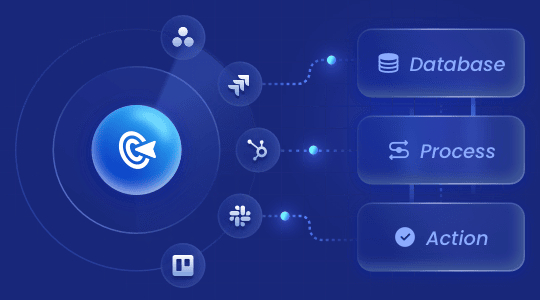
In this type of setup, the platform can help teams:
- pull CRM data such as ARR, renewal date, health score, and recent ticket history in real time
- analyze ticket language for urgency, repeated complaints, escalation signals, or sentiment shifts
- apply routing logic based on both structured rules and AI interpretation
- trigger downstream actions such as ticket tagging, Slack alerts, task creation, or customer notifications
A workflow like this does not replace your helpdesk or CRM. It sits across them, helping route tickets with more context than standard queue logic alone.
A simple implementation path might look like this:
1. Connect your CRM and ticketing system.
2. Define your initial high-value account rules.
3. Add AI-based intent detection for escalation language or repeated complaints.
4. Route qualified tickets to a dedicated queue, senior specialist, or renewal workflow.
5. Monitor routing decisions and refine the logic over time.
Note: This is just a relatively idealized and simple process. The right implementation will vary by team size, system complexity, and support model. But the core principle stays the same: better routing decisions come from combining customer context with issue context.
Conclusion
Blind routing doesn't fail because it's broken, it fails because it lacks context. When every ticket is treated equally, high-value customers slip through the cracks, especially when it matters most. The fix is simple: combine CRM data, AI intent detection, and smart routing to prioritize what actually matters. That means faster responses, better visibility, and fewer at-risk renewals. Smarter ticket routing isn't just a support upgrade, it's a retention strategy.
If you want to eliminate the VIP Blind Spot without building it from scratch, platforms like GoInsight.AI offer a faster way to put this into practice.
Are your high‑value tickets getting lost in standard queues? GoInsight.AI connects your CRM and helpdesk to detect urgency, prioritize VIP accounts, and alert Customer Success before a renewal is at risk.
Start 30 Days TrialFAQs



Leave a Reply.