Living in the cybernetic era, the software iteration times are high-speed. Most software companies are trying to validate builds quickly and reliably without risking release timelines. If they slow down, they're going to fall behind.
Fast software delivery, however, brings Quality Assurance (QA) teams increasing pressure because ensuring the software version under test meets defined quality standards is not an easy thing. In the past, bug testing required manual effort among diverse teams, which led to low efficiency, high risk of errors, and even friction between QA and development teams. To change the bug testing process, our QA and R&D teams came up with a workflow automation solution using GoInsight.AI.
Challenges
Before adopting the automated workflow, our teams followed a highly manual process and have faced the obstacles that most QA and R&D teams could connect with.
Time-consuming in reviewing Jira defects
During every test iteration, our QA engineers used to manually log in to Jira to check the status of all existing bugs associated with the current release version. Engineers must determine whether unresolved faults have been repaired, particularly high-priority ones that could prevent testing. This process could take minutes or even hours, slowing down software iteration.
Inefficient follow-ups
In Jira, there are statuses that represent the various stages that an issue, like a bug or a task, can go through in its life cycle. However, the statuses don't always tell the actual conditions. In the past, our QA team needed to chase the development or product team to confirm whether the issue had genuinely been resolved or simply updated. Similarly, if a version was ready to test after debugging, QA had to notify relevant assignees or teams. Because all follow-ups took place outside of any structured channel, delays often occurred in test planning and coordination.
Solution
To address these challenges, our team designed and deployed an automated workflow that leverages Python scripting, Node, and AI to streamline bug readiness assessment.
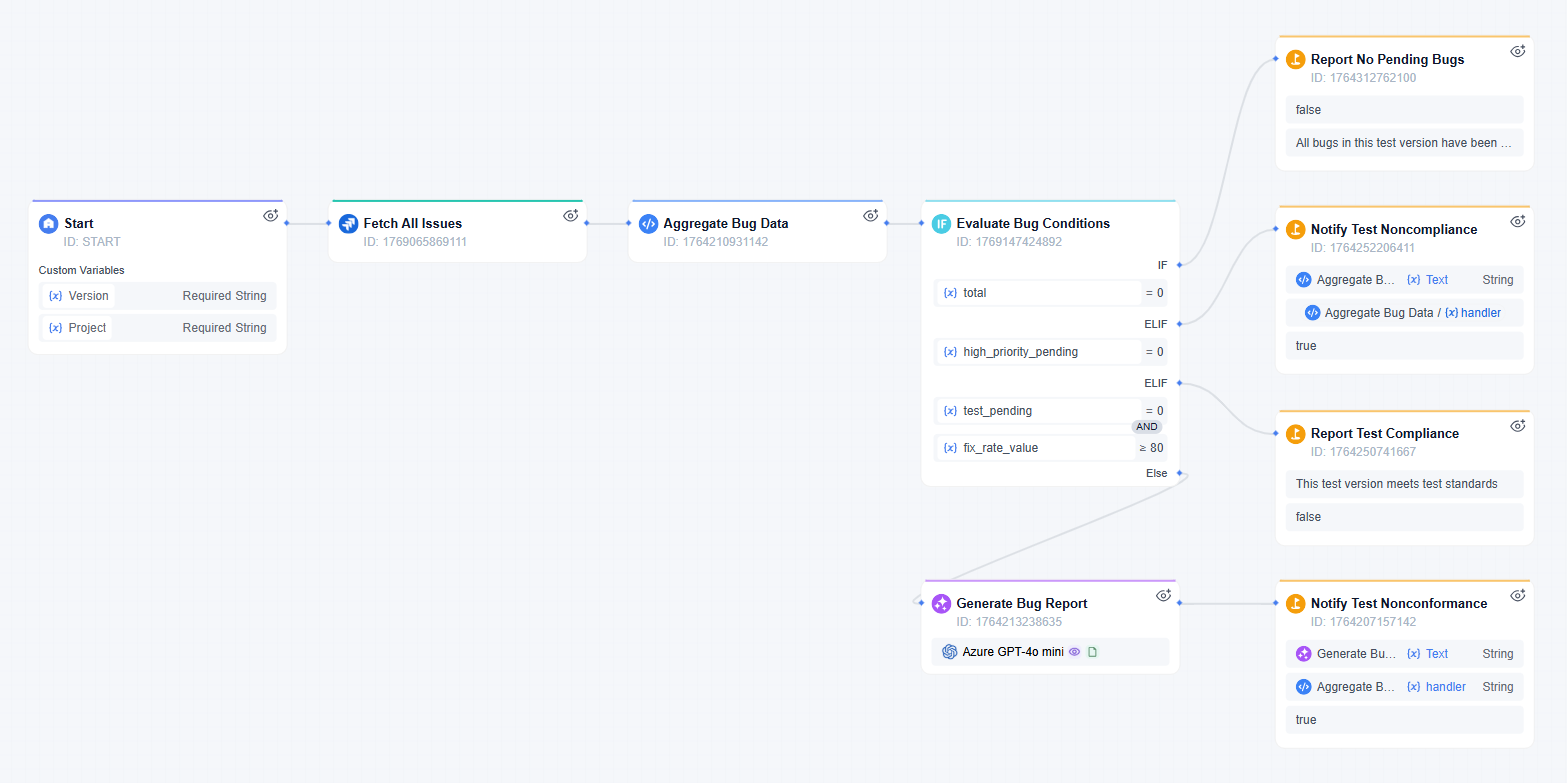
Automated trigger
When the development team initiates a test cycle or flags a new release version as ready for QA review, the workflow is triggered and automatically captures data in bug statuses, rather than requiring QA to initiate any manual checks.
Data extraction and analysis
After checking the statuses, the workflow will apply a Python script to pull data associated with the target version from Jira. Then, it'll show bug counts, calculate fix rate, identify priority of bug fixing, etc., and gather information of the developers responsible for remaining defects for the next stage.
LLM nodes for insightful report
AI ability is also introduced within this workflow. The LLM node helps generate a structure defect report that can indicate the priority of unsolved defects, tell the overview of the current landscape, and link to Jira tickets. Also, the assignees will be mentioned in the report, ensuring they can follow up on the issue in time.
Results
Now, version iterations and bug testing in our team is another story with GoInsight.AI. The workflow delivers improvements om efficiency, accuracy, and team collaboration.
QA engineers no longer log into Jira and manually track bug statuses. This change helps to shorten test cycles, particularly between development handoff and test execution. It also increases transparency and accountability in the process. Developers and the product team can be notified as soon as their action is required, which reduces back-and-forth communication overhead. Most importantly, its capacity to automatically identify and warn of unresolved defects assists teams in avoiding hidden blockages, which can help reduce the risk of missing bugs, allowing the business to ensure a high speed in software iteration cycles.





Leave a Reply.