

- From BI to Agentic Analytics: What Actually Changes
- Where Data Analysis Agents Deliver Real Business Value
- Challenges and Solutions of Deploying AI Agents for Data Analysis
- Building Governed AI Agents for Enterprise Data Analysis
- A Practical Walkthrough: How to Build a Governed Data Analysis AI Agent
- The Future: Autonomous Yet Governed Analytics
- Final Words
- FAQs
For years, data analysis has followed a familiar rhythm: gather data, clean it, run queries, build dashboards, and gradually turn numbers into insights. Reliable, yes—but not always fast or flexible.
As organizations generate more data than ever, teams need answers in minutes, not days, and insights that keep up with rapidly changing business questions. This demand is driving a shift toward AI agents for data analysis. The market for AI-driven analysis is projected to grow from $1.5 billion in 2024 to $38.1 billion by 2034, reflecting a move to more autonomous workflows.
But this raises a critical question: should enterprises invest in AI agents for data analysis, and how can they deploy them effectively and securely? In this article, we examine their business value, deployment challenges, and practical solutions for success.

From BI to Agentic Analytics: What Actually Changes
In the past decade, data analysis has largely followed a predictable pattern:
- A business user identifies a question.
- A data analyst translates that question into an SQL query.
- The query runs against a database.
- A dashboard visualizes the results.
However, agentic analytics flips this model. Without the need to ask any questions, data analytics agents proactively scan datasets, recognize trends, flag anomalies, and generate hypotheses. Plus, they run queries, verify findings, set off alerts, and present conclusions with supporting evidence.
Quick Comparison Table: Traditional BI vs Agentic Analytics
| Dimension | Traditional BI | AI Agent Analytics |
|---|---|---|
| Query | Manual SQL | Natural language |
| Workflow | Human-driven | Autonomous |
| Insight generation | Static dashboards | Dynamic analysis |
| Tool usage | Single tool | Multi-tool orchestration |
| Action | Insight only | Insight + execution |
Industry data confirms the efficiency gains delivered by AI agents: compared to traditional workflows, companies that adopt AI agents consistently report a 66% increase in productivity.
This is also the case at GoInsight.AI. One company we worked with previously spent 4 to 5 hours each week manually reviewing transaction anomalies across multiple dashboards. After deploying our data analysis agent, the same review process took just 8 minutes to complete, reducing manual effort by over 90%.
Where Data Analysis Agents Deliver Real Business Value
For most businesses, the concept of data analysis AI agents can seem abstract. Enterprise leaders might wonder: how do AI agents actually help day-to-day? Let’s look at several enterprise use cases where AI agents for data analysis already deliver practical, measurable value.
1. Automated Data Exploration
Many analytical insights start with exploration, and data analysis agents can automate this process. Take revenue decline detection as an example: an AI agent for monitoring sales data notices a 12% turnover decline in a specific region and jumps into action:
- It checks related metrics: traffic, conversion rates, and average order value.
- Correlates the change with external factors like seasonality or competitor activity.
- Within minutes, the agent presents a hypothesis: a pricing change in one channel caused market cannibalization.
Churn pattern analysis works similarly. Say there’s this AI agent that tracks customer behavior. It spots subtle signals preceding cancellations. Perhaps users who stop using a specific feature within 30 days show 40% higher attrition risk. The agent flags these patterns before customers leave, helping improve retention rates.
2. Self-Service Analytics at Scale
Most enterprise employees lack SQL skills. And many of them depend on data teams for every query, creating bottlenecks. AI agents change this dynamic. A product manager stationed anywhere in the world can ask an agent in plain language: "Why did conversions drop in APAC last week?"
An AI-powered analytics assistant will immediately:
- Queries the relevant databases and warehouses.
- Generates a time-series chart showing conversion trends.
- Compares that data with recent product releases or marketing campaigns.
- Provides a written explanation: "Conversions dropped on Tuesday following a pricing page update that increased load times by 1.2 seconds."
All of this happens within minutes and without the need for middleware.
3. Continuous Monitoring and Alerts
Static dashboards show what has already happened. But an enterprise needs to know about issues as they occur, or even before they occur. AI agents solve that problem through continuous analysis and alerts.
For instance, an agent watching transaction volumes notices a rise in failed payments. It immediately alerts the payments team with context: affected regions, card types, and start time.
4. Automated Business Reporting
Weekly reports, operational summaries, and market intelligence documents consume thousands of hours of human time each year. Data analysis AI agents can handle business reporting entirely.
For instance, a sales operations team can have an agent that, every Friday afternoon, pulls the week's pipeline data, compares it to targets, generates summary charts, and drafts a narrative of the week's performance.
The overall value for organizations is huge: a combo of speed, scale, and consistency. Decisions happen faster because insights arrive sooner. Plus, quality improves because agents apply uniform methodologies across all analyses.
Challenges and Solutions of Deploying AI Agents for Data Analysis
Deploying autonomous agents in an enterprise is not a simple plug-and-play process. The reality is far more complex, with governance, security, AI hallucinations, and integration all being factors that enterprises must take into account.
Challenge 1: Data Governance and Security Risks
Enterprise datasets often include sensitive information, such as financial records, health records, customer profiles, and internal communications. Allowing independent systems to query that data raises some obvious concerns. Without controls, agents might expose confidential information, violate compliance requirements, or make unauthorized changes.
Solution:
A practical approach is to implement role-based authorization so AI agents can only access the data required for their tasks, reducing unnecessary exposure of sensitive information. At the same time, maintaining comprehensive audit trails allows organizations to trace every query and system action, helping detect anomalies and support compliance requirements.
Challenge 2: AI Hallucination in Analytical Outputs
Large language models sometimes generate plausible-sounding but factually incorrect outputs. In analytics, this means wrong numbers, false trends, or misleading conclusions. A hallucinated sales figure or a misinterpreted trend can lead to bad decisions.
Solution:
Instead of letting the agent "guess" the answer from its training, the architecture should force it to retrieve information from trusted, verifiable sources. Enterprises can achieve it through techniques like RAG combined with rule-based data queries. The system should also present the source data, query logic, and calculation steps so humans can verify the results.
Challenge 3: Integration with Enterprise Data Systems
Enterprise data rarely lives in a single place. It is typically distributed across warehouses, SaaS tools, internal databases, and legacy systems. This fragmented landscape makes it difficult for AI agents to access consistent, reliable data. Without proper integration, agents may retrieve incomplete information, generate inconsistent insights, or struggle to operate across multiple systems.
Solution:
Organizations should adopt standardized integration layers such as APIs, data connectors, or unified semantic layers. These allow AI agents to access multiple systems through a consistent interface while ensuring data consistency, permission control, and reliable cross-system analysis.
Building Governed AI Agents for Enterprise Data Analysis
Enterprises don’t just need AI agents that can analyze data, they need ones that operate within clear boundaries, use the right context, and produce outputs they can trust. This requires a governed layer between AI and enterprise data systems.
GoInsight.AI is designed to provide enterprises with a controlled environment for deploying AI agents that interact with internal data systems. Instead of giving AI models unrestricted access to databases or business tools, it introduces a governance layer that manages how data is accessed, processed, and validated.
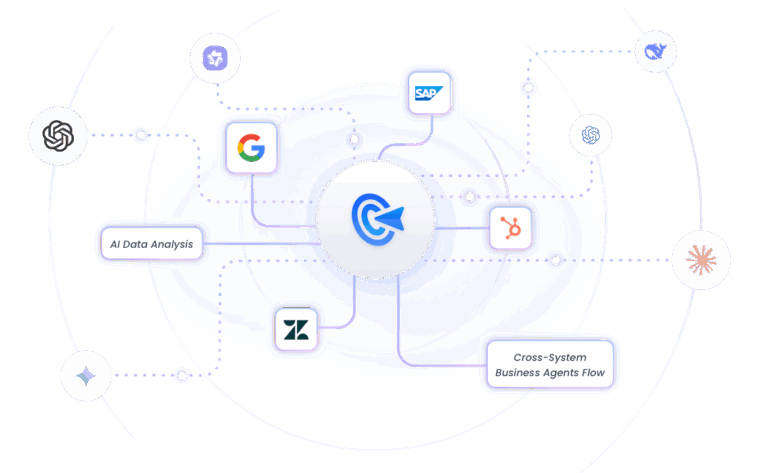
What GoInsight.AI Provides:
- Governance: Enforce role-based access control to ensure agents only interact with authorized data, while full-chain audit logs provide complete visibility into every query and action.
- Security: Introduce a controlled access layer between AI and enterprise systems, with built-in human-in-the-loop checkpoints to review and validate outputs before they are used.
- Explainability: Ground AI outputs using RAG and structured internal knowledge bases, ensuring insights are consistent with business definitions and traceable to reliable sources.
- Integration: Connect AI models, automation tools, databases, and business systems into a unified workflow, enabling agents to operate seamlessly across existing enterprise environments.
Together, these capabilities ensure AI agents are not only powerful, but also controlled, reliable, and enterprise-ready.
A Practical Walkthrough: How to Build a Governed Data Analysis AI Agent
To deploy a secure and effective data analysis AI agent with GoInsight.AI, enterprises can follow this streamlined approach:
- Define a focused use case
- Start with a clear, bounded scenario—such as weekly KPI reporting, campaign performance analysis, or internal data Q&A. Narrow scope helps ensure better control and measurable impact.
- Connect and govern data access
- Integrate relevant data sources (e.g., databases, BI platforms, Google Sheets) and configure permissions. Ensure the agent only accesses the data required for its specific role.
- Establish a knowledge foundation
- Build a centralized knowledge base that includes metric definitions, business rules, and reporting standards. This ensures the agent interprets data consistently and avoids ambiguity.
- Design the analysis workflow
- Configure how the agent retrieves data, performs calculations, and generates outputs (e.g., summaries, insights, or reports). Structure the workflow to reflect real analytical processes.
- Validate, deploy, and iterate
- Add human review checkpoints where needed, then deploy the agent into real workflows. Continuously monitor performance, refine logic, and expand use cases over time.
This step-by-step approach allows organizations to move from isolated AI experiments to scalable, governed deployments that deliver reliable data insights.
The Future: Autonomous Yet Governed Analytics
Agentic analytics is moving toward greater autonomy. The real question is not whether data analysis AI agents will take on more responsibility, but how organizations will manage that shift. Three key trends will shape the years ahead:
Trend 1: Agentic Analytics Will Become Default
Within the next five years, interacting with enterprise data through conversational, autonomous agents will be as common as using a search engine is today. Gartner’s projection that 33% of software will include agentic AI by 2028 is just the beginning – the real momentum will build as these systems prove their ROI.
Trend 2: Multi-Agent Data Systems
One agent monitors data quality. Another scans for market trends. A third might handle regulatory compliance checks. These agents will communicate with each other, passing context and findings back and forth. The result is a more modular and resilient analytics architecture, where tasks are distributed, validated, and continuously refined—much closer to how real organizations operate.
Trend 3: Marketplace of Certified Agents
As enterprise AI matures, curated marketplaces with vetted, certified agents are emerging, allowing organizations to discover, compare, and deploy task‑specific agents quickly. This trend accelerates adoption by reducing build time, improving trust through certification, and enabling plug‑and‑play agent ecosystems across industries.
Final Words
AI agents for data analysis offer unprecedented speed and scale – handling data exploration, monitoring, and reporting so that human analysts can focus on strategy and judgment.
But enterprises must balance autonomy with control and governance. They need systems that act independently yet remain accountable. The goal is to build a digital workforce that operates alongside humans, with the same respect for rules and boundaries. And that is a future worth building.
FAQs

AI agents can connect to a variety of enterprise data sources, including:
- Databases and data warehouses
- BI platforms and analytics tools
- Spreadsheets such as Google Sheets or Excel
- SaaS tools such as CRM or marketing platforms
- Internal documents and knowledge bases
- APIs and other structured data sources


Leave a Reply.