 ">
"> Highlights
- • Automated 24/7 monitoring to replace hours of manual website inspection
- • Reclaiming team hours to focus on high-value product innovation and strategy
- • Dual-layer AI analysis that extracts both micro-features and macro-market trends
Overview
The Sand Studio product team operates in a fast-moving market where staying updated on competitor moves is a strategic necessity. One essential task is monitoring industry changelogs to track new features. Previously, this process was a manual burden that distracted the team from their core creative work.
The challenge
Before using GoInsight.AI, the product team faced three main difficulties:
Manual Inspection Costs: Team members had to visit competitor sites every week. This repetitive task was time-consuming and prone to being skipped during busy periods.
Low Processing Efficiency: Summarizing technical logs by hand was slow, often causing the team to miss macro-level strategic signals.
Delayed Intelligence: Manual checks meant the team was often days or weeks behind the latest market updates.
The solution: automated strategic insights
The product team built a 24/7 monitoring workflow to handle the entire intelligence cycle—from initial data capture to high-level strategic reporting.
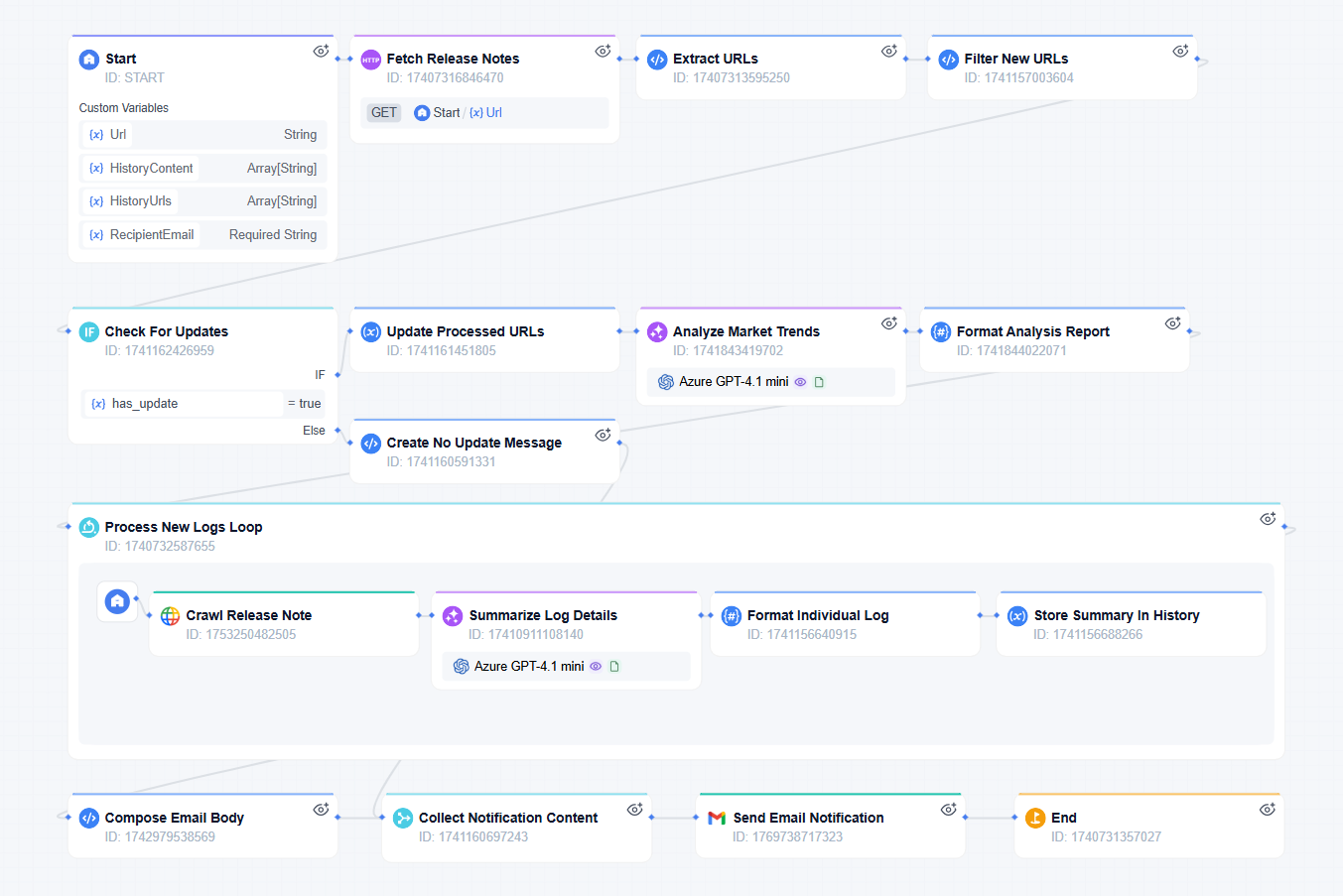
How the workflow works
- Smart Incremental Detection
- The workflow runs on a schedule. A Python-based node identifies new links and compares them against a history list, ensuring only new content is processed.
- Micro-Analysis (The Loop)
- For every new update, the system extracts details and provides a summary of the specific feature updates added.
- Macro-Analysis
- The AI aggregates historical data to generate reports on technical directions and market strategies, providing a global view of competitor shifts.
- Multi-Channel Distribution
- Reports are pushed to the team's group chat for instant alerts and saved in a shared workspace for long-term knowledge retention.
The star feature: Layered AI Analysis
The standout feature of this workflow is the Layered AI Analysis. Instead of a basic summary, the workflow uses a two-step cognitive approach. The first layer captures the "what" (feature updates), while the second layer explains the "why" (strategic goals and roadmap).
This zero-code logic allows the product team to act as analysts rather than data collectors. The platform allows users to build entire workflows and then publish them as standardized tool nodes. Because it is a standardized tool, the workflow can be adapted to track new market leaders just by changing a URL.
The impact
Reclaiming time for innovation
By automating manual inspection, the product team has eliminated up to an hour of tedious work per week. This time is now reinvested into high-value product innovation and roadmap planning.
Zero-lag market intelligence
Gathering insights has moved from "weekly" to "hourly." This speed advantage ensures that the team can respond to market changes as they happen.
Higher decision quality
Every update comes with a structured analysis of market goals and technical architecture. This directly supports the team in making data-backed decisions for their own product strategy.
What's next
The product team plans to reuse this framework to track industry policy updates and technical blogs. As the team expands its use of the Collaborative Workbench, this "Digital Analyst" will become a shared resource for marketing and operations teams alike.
"This workflow acts as a digital analyst. It handles the manual grind of monitoring, allowing our team to spend their energy on strategic thinking and product innovation."
Bring your team, systems, and AI into one place—then turn ideas into governed work.
Start Free Trial





Leave a Reply.