

- How Automated Sentiment Analysis Works
- The Four-Step Process
- What Makes Stock Sentiment Analysis Unique?
- Three Primary Sources of Market Sentiment
- Financial News & Media
- Social Media & Retail Sentiment
- Market Data & Options Flow
- Three Leading Sentiment Analysis Tools
- Bloomberg Terminal
- StockTwits
- MarketPsych Analytics
- A Lightweight Approach: News-Focused Sentiment Analysis Workflow
- GoInsight.AI
- 5 Practical Tips for Using Sentiment Analysis
According to an AIMultiple study, sentiment-informed models can reach 60–85% prediction accuracy, depending on data quality, dataset size, and use case.

Stock market sentiment analysis categorizes market-related text as positive, negative, or neutral, helping investors make more informed trading decisions. However, manually tracking sentiment across dozens of news sources and platforms is time-consuming and inconsistent for individual investors. That's where automated sentiment analysis becomes invaluable.
How Automated Sentiment Analysis Works
Automated sentiment analysis uses natural language processing (NLP) and machine learning to read and categorize large volumes of financial text far faster than any human could manually.
The Four-Step Process
1. Data Collection
Financial text is gathered from sources such as news outlets, press releases, earnings reports, and regulatory filings.
2. NLP Processing
The system cleans and analyzes the text, breaking it into components to understand structure and meaning.
3. Sentiment Scoring
Articles and sentences are assigned sentiment values (positive, negative, or neutral), often on a numerical scale.
4. Insight Generation
Scores are aggregated into dashboards, alerts, or summaries that highlight trends and key drivers.
In simple terms: the system reads the news, decides how "good" or "bad" it sounds, then explains why.
What Makes Stock Sentiment Analysis Unique?
Compared to general sentiment analysis, stock-focused sentiment presents distinct challenges:
- Financial Language Complexity
Terms like "bearish rally" or "technical correction" carry meanings that differ from everyday language and can make understanding market trends needlessly complex. - Context-Dependent Interpretation
Interpreting market news depends heavily on context. While a headline like "Company A misses earnings expectations" is typically construed as negative, it could be a positive if expectations were already extremely low. - Timing Sensitivity
News released pre-market, during trading hours, or after close can trigger very different reactions.
Three Primary Sources of Market Sentiment
Sentiment analysis tools typically draw from three core data sources, each reflecting a different layer of market psychology.
1. Financial News & Media
What it includes:
Major financial publications, news outlets, earnings reports, press releases, analyst commentary, etc.
- Curated & professionally written by experts & trusted analysts
- Lower emotional volatility
- Clear narrative framing; provides context to market trends & changes
- Strong institutional influence; directly affects stakeholders who move significant capital
What it captures:
Financial news reflects how professionals and institutions view the market. Written for analysts, fund managers, and large investors, it focuses on fundamentals such as earnings, guidance, and economic conditions. This makes it best suited for tracking long-term market narratives.
2. Social Media & Retail Sentiment
What it includes:
Forums, investing communities, comment threads, social media platforms (LinkedIn, X), community-driven platforms (Reddit, Discord), sharing opinions and reactions to market moves.
- Highly emotional and reactive
- Typically focused on short-term movements
- Prone to hype cycles & noise
- Strong, relatable retail investor presence & voices
What it captures:
Social sentiment reflects how everyday investors feel in real time.
It often captures excitement, fear, and panic around price moves, making it useful for spotting short-term momentum, but less reliable for long-term value.
3. Market Data & Options Flow
What it includes:
Market signals based on real-world trading behavior, investor activity, volatility levels, futures positioning, etc.
- Raw quantitative data, instead of textual reports
- In most cases, driven by institutions
- More complex and requires technical interpretation
- Less (if none) narrative context
What it captures:
This data shows what traders are doing with their money, revealing risk positioning and expectations. While powerful, it often lacks the context needed to explain why sentiment is shifting.
Which Source Should You Prioritize?
For most individual investors and analysts, financial news sentiment has the best balance of actionable insight and clarity. Oftentimes, it accurately reflects institutional narratives, is easier to interpret, and avoids emotional noise common in social media sources.
Three Leading Sentiment Analysis Tools
1. Bloomberg Terminal
The Bloomberg Terminal is widely used by banks, hedge funds, and other large institutions. Rather than presenting sentiment as a standalone score, Bloomberg places it alongside price movements and company fundamentals.
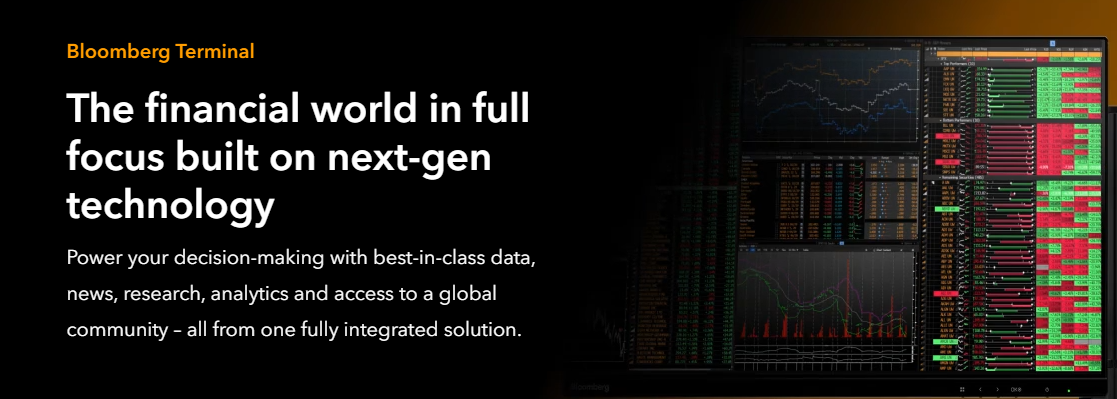
Strengths: Deep integration of news, market data, and analytics.
Limitations: Extremely expensive and can be too complex for solo, everyday traders.
Best for: Professional traders and institutional investors.
2. StockTwits
The sentiment on StockTwits reflects how retail investors are feeling at any given moment, providing a useful space to spot sudden increases in interest or concern.
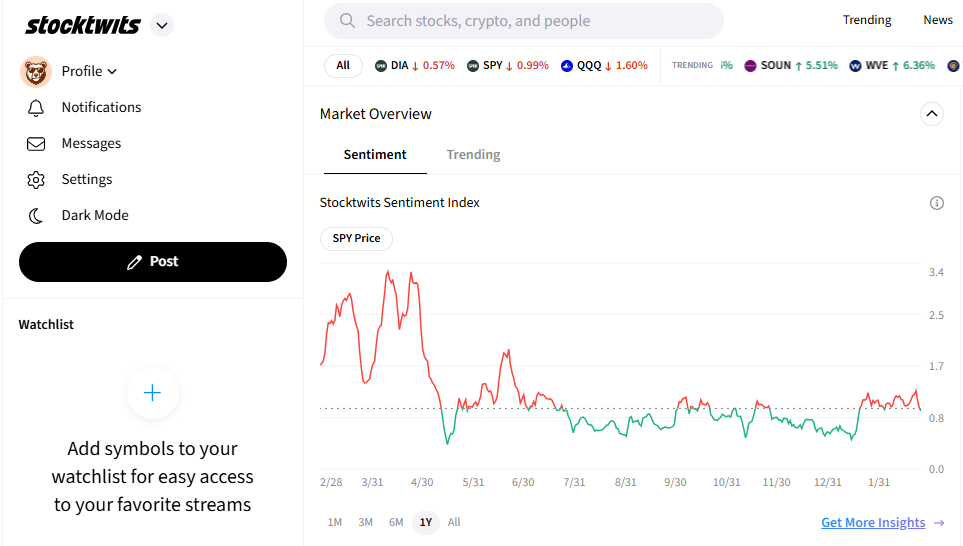
Strengths: Real-time insights into retail investor sentiment.
Limitations: Can be noisy and heavily influenced by emotion.
Best for: Tracking & spotting short-term momentum and market attention shifts.
3. MarketPsych Analytics
MarketPsych Analytics uses AI-based language models to produce structured, accurate sentiment signals across financial news and reports.
Strengths: Specifically designed to interpret & analyse financial language.
Limitations: Highly technical and primarily targeted for enterprise users.
Best for: Data-focused investment teams and quantitative analysts.
A Quick Comparison
| Tool | Data Source | Price Range | Best For |
|---|---|---|---|
| Bloomberg Terminal | News + Market Data | Very High | Institutions |
| StockTwits | Social Media | Free/Low | Retail Momentum |
| MarketPsych | News + Data Feeds | High | Quant Analysis |
A Lightweight Approach: News-Focused Sentiment Analysis Workflow
For retail investors, the biggest hurdles are a lack of time and emotional bias. Most people cannot track 100 news sources or prioritize information effectively. GoInsight.AI offers a lightweight, news-focused solution: the Stock News Sentiment Analysis Report Generator.
This template strips away market noise to provide a foundational, logic-based overview of current sentiment.
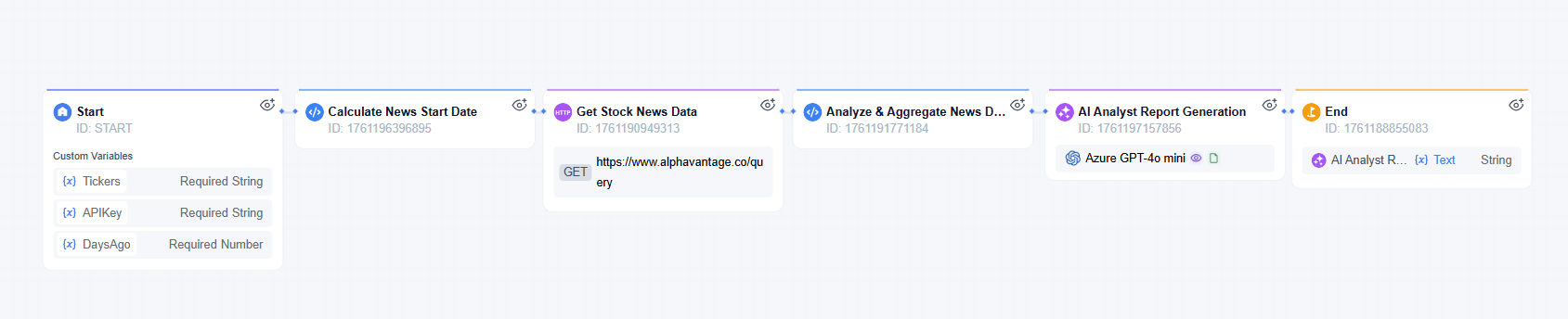
The core advantage
- Professional data source: Powered by the Alpha Vantage API, the template pulls high-quality data from professional financial news feeds, ensuring your analysis is built on verified information rather than unverified social media chatter.
- News-focused filtering: It scans headlines to remove filler content and hype, protecting you from being misled by extreme or sensationalist opinions.
- Lightweight data processing: It turns fragmented news into basic, structured statistics to identify core factors—such as production volume or margin shifts—influencing the stock.
- Essential logic: Instead of a simple "good or bad" score, it provides a basic explanation of the reasoning behind the sentiment to help you stay grounded.
5 Practical Tips for Using Sentiment Analysis
- Combine with fundamentals: Use sentiment for mood and fundamentals for value.
- Watch for divergence: Look for cases where price and sentiment move in opposite directions.
- Understand data source bias: Interpret sentiment across multiple sources.
- Track velocity: Rapid changes in sentiment often matter more than absolute scores.
- Know when to ignore it: Be cautious with small-cap stocks or illiquid markets.
Conclusion
Automated sentiment analysis helps investors interpret market psychology at scale. By combining it with traditional analysis, individual investors can gain clearer, more consistent insights without sifting through overwhelming noise.





Leave a Reply.