
Businesses worldwide are racing to adopt artificial intelligence for enhanced efficiency and productivity. Despite obtaining loads of marketing data with AI, nearly 79% of US businesses are unable to convert marketing leads into sales - not because of poor demand, but due to ineffective lead qualification and prioritization.
And that's where AI lead scoring comes into play. These AI agents have become the most powerful tool to optimize lead rankings in real time to ensure high conversion rates for businesses of all types and sizes.
What is AI Lead Scoring
AI Lead Scoring is a data-driven way to evaluate how likely a potential customer is to make a purchase. Unlike traditional lead scoring, which relies on static rules, this approach utilizes machine learning models to analyze large volumes of user data and interactions from multiple sources, including website visits, email responses, social interactions, and purchase history.
Based on this information, the AI agents rank and prioritize marketing leads according to their sales readiness. The system learns from past conversions and patterns to automatically update its scoring criteria as it gathers more insight.
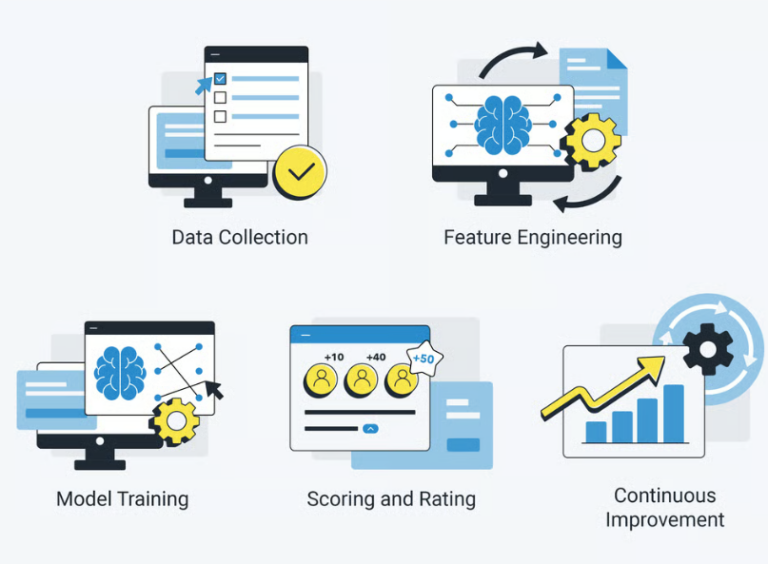
Use Case Example: If the AI agent detects that leads who attend webinars are 40% more likely to convert, it will start giving higher priority to similar behaviors. Over time, the model becomes more accurate and personalized, which allows sales teams to focus their time and energy on the most promising leads.
In short, AI Lead Scoring turns guesswork into data-backed prediction, offering companies a faster and more reliable way to identify high-value customers.
How AI Agents Differ from Gen AI Tools
It's crucial to understand that the AI agents in Lead Scoring are not the same as the generative AI tools like ChatGPT or DeepSeek. They are built for different jobs and purposes altogether.
Generative AI tools excel at producing content or summarizing information. They are reactive by design as they wait for prompts from users before performing a task. AI Agents, on the other hand, are autonomous and goal-driven. They don't just respond; they act, decide, and learn on their own within continuous human instructions.
In the context of lead scoring, an AI Agent:
- Analyzes lead behavior and firmographics from your live data sources.
- Decides which leads are hot based on learned patterns.
- Acts by updating a score in your CRM or routing the lead to a sales rep.
So, Gen AI tools are meant for assisting with tasks while AI agents are designed to execute a core business process.
What Can you Do with AI Lead Scoring Agents?
Here are some of the main ways businesses use these cool AI tools:
Prioritize the Best Leads
This is the biggest and most obvious use case! Instead of treating all leads the same, AI agents analyze tons of data—like how a person interacts with your website, their job title, company size, and even social media activity—to assign a score. This means your sales team can focus their energy on the leads with the highest scores, who are basically waving a flag saying, "I'm ready to talk!"
- What it solves: Prevents sales reps from wasting time on leads that aren't a good fit or aren't ready to buy.
- Result: Faster sales cycles and higher conversion rates.
Personalization on Autopilot
AI doesn't just score leads; it also uncovers why a lead got a certain score. For example, it might notice a lead is really interested in a specific product feature because they read three blog posts about it. This insight allows marketing and sales teams to personalize their communication.
- What it solves: Generic, one-size-fits-all marketing messages that don't resonate.
- Result: More engaging emails, better ad targeting, and conversations that are actually relevant to the lead's interests.
Improve Your Marketing Campaigns
By analyzing which marketing channels (like Google ads, webinars, social media, etc.) bring in the highest-scoring leads, the AI helps you understand what's working and what's not. You can then double down on the successful channels and cut spending on the ones that only attract window shoppers.
- What it solves: Wasting marketing budget on campaigns that don't generate valuable leads.
- Result: Better return on investment (ROI) for your marketing efforts.
Align Sales and Marketing Teams
Sometimes, sales and marketing teams have different ideas about what makes a "good" lead. An AI lead scoring system creates a single, data-driven definition that everyone can agree on. When marketing passes a lead to sales, sales knows it's been vetted by an objective system and is worth their time.
- What it solves: The classic friction between sales and marketing.
- Result: Smoother collaboration and a more efficient process from initial contact to final sale.
In a nutshell, AI lead scoring agents help businesses work smarter, not harder, by focusing their resources where they'll have the biggest impact. It's all about using data to find your future best customers!
If you'd like, I can dive deeper into how these systems work or suggest some popular AI lead scoring tools!
Why Your Business Needs AI Lead Scoring: 4 Core Benefits
Today, businesses of all sizes and niches are employing AI lead scoring agents in their daily operations. Here are the top benefits of integrating AI lead generation into your business:
1. Higher Accuracy and Smarter Predictions
AI Lead Scoring agents continuously analyze thousands of data points from multiple sources, like email opens, website visits, and purchase patterns. Instead of using a static rule-based scoring system, they prioritize only the hottest, sales-ready leads that are most likely to convert.
Unlike traditional scoring methods, AI Agents continuously learn and refine their models, improving accuracy over time.
2. Increased Sales Productivity
AI leads agents filter out and route the best leads from the available pool of information. This saves sales reps from time-consuming manual sorting as they get a daily shortlist of top prospects prioritized by conversion likelihood. This means more time spent building relationships and closing deals, rather than managing spreadsheets or data.
3. Real-Time Adaptability
The biggest advantage of AI lead generation is its continuous adaptability with your specific business needs. As soon as a customer engages with your website, downloads content, or interacts with campaigns, their AI lead score is instantly updated.
Moreover, the system updates the scores whenever new data arrives from CRM updates and customer interactions. This allows businesses to respond instantly to changes in buyer intent.
4. AI-driven Data Insights
AI-driven scoring provides transparent, data-backed insights that both sales and marketing teams can trust. Both teams rely on the same data-driven scoring system, minimizing friction and ensuring smoother handoffs from marketing-qualified leads (MQLs) to sales-qualified leads (SQLs).
Use GoInsight.AI to Train AI Agents for Effective Lead Scoring
When it comes to implementing AI Lead Scoring in real business environments, GoInsight.AI stands out as a powerful all-in-one solution for data-driven sales intelligence.
Designed for enterprises AI-powered automation and collaboration, it enables teams to automate and train AI agents for consistent and accurate Lead Scoring.
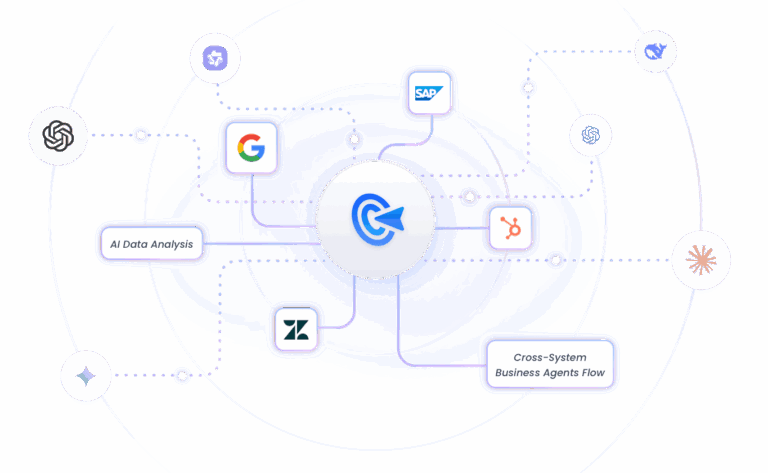
How GoInsight.AI Allows Companies to Leverage AI Lead Scoring
- Custom Knowledge Bases: It allows HR teams to build knowledge bases and upload the company's data to better train the AI Lead Scoring agents. Connect all your internal databases or spreadsheets to this knowledge base.
- Build and Deploy AI Agents: With its no-code, visual editor, even non-technical users can build smart AI agents within minutes. It also supports seamless integration of these agentic AI with your existing business systems, which is a key to accurate lead scoring.
- Train and Optimize the Agents: GoInsight.AI allows you to upload historical lead data (won vs. lost deals) to let the AI model analyze which signals best predict conversions.
- Incorporate Human-in-the-Loop (HITL) Validation: AI predictions are powerful, but human judgment adds precision. GoInsight.AI's Human-in-the-Loop feature lets your sales or marketing team review, approve, or adjust scores before they are finalized.
- Enterprise Security: Built with enterprise-grade security compliance and scalability at its core.
Best Practices for Accurate AI Lead Scoring
To harness AI-powered Lead Scoring systems, businesses need a structured approach that combines clean data, automation, and continuous learning.
Consider the tips below:
1. Use Clean, Unified Data
AI is only as good as the data it learns from. For accurate scoring, ensure all customer data, like CRM entries, website analytics, email interactions, and sales history, is clean, updated, and consistent.
Tip: Be sure to regularly audit and standardize data sources before feeding them into your AI system.
2. Define Clear Success Metrics with Sales Alignment
Market statistics reveal that the biggest pitfall in AI lead scoring is misalignment between marketing and sales on what constitutes a qualified lead. To counter this, maintain close alignment between the sales and marketing teams.
When teams share a unified definition of success, AI Lead Scoring becomes far more accurate and impactful.
3. Blend Human Expertise with Machine Intelligence
The idea is to bring humans into the loop. AI Lead Scoring shouldn't replace human judgment; rather it should enhance it. The teams should regularly review AI-generated scores to validate accuracy and provide feedback that improves model learning.
As a business manager, you can schedule quarterly review sessions where AI recommendations are compared against real sales outcomes. Then, adjust algorithms accordingly for higher precision.
4. Continuously Train and Update Your AI Agents
Markets, buyer behavior, and sales strategies evolve over time. To keep AI predictions relevant, regularly retrain models using new data and recent conversion trends. This is what differentiates a modern AI Lead Scoring agent from traditional Gen AI tools.
Tip: Platforms like GoInsight.AI make this process seamless with built-in retraining pipelines and feedback loops.
5. Integrate AI Lead Scoring with Automation Workflows
The real power of AI Lead Scoring lies in automating what happens next. Route high-priority leads to sales immediately, trigger personalized nurturing campaigns for medium scores, and recycle low scores for future re-engagement.
Tip: Here again, you can seek assistance from GoInsight.AI to link lead scoring directly to workflow automation. This ensures real-time routing and follow-ups without manual intervention.
FAQs
Q. What types of data does AI use to score leads?
AI Lead Scoring uses almost all the available digital data of user interactions, including:
- Behavioral data: Website visits, email clicks, webinar attendance, content downloads.
- Demographic or firmographic data: Industry, company size, role, or location.
- Engagement data: Frequency, timing, and recency of interactions.
- Historical performance data: Traits of leads that converted successfully in the past.
Q: How can AI Lead Scoring improve sales performance?
AI agents for Lead Scoring help sales teams prioritize leads that are most likely to convert into purchases. This ensures faster, smarter, and efficient decision-making as well as reduces wasted effort on low-quality prospects. Moreover, AI-generated insights allow for more personalized outreach and better timing of follow-ups.
Q. Is AI Lead Scoring suitable for small and medium businesses (SMBs)?
Yes, it is. Though large businesses typically use AI Lead Scoring, the platforms like GoInsight.AI make AI Lead Scoring accessible to SMBs by offering scalable, low-cost tools. Even smaller teams can benefit from automated insights that optimize time and resources, without needing dedicated professionals.





Leave a Reply.