

- The Four Distinct Classes of Opportunities
- 1. Supporting Current Practices
- 2. Replacing Current Practices
- 3. Filling Existing Gaps
- 4. Creating New Kinds of Data and Insights
- What These Opportunities Teach Us
- On Operational Inspiration
- On Strategic Transformation
- Real-World Applications
- Consumer Insight Automation
- Synthetic Data Generation
- Predictive Demand Modeling
- Virtual Product Testing
- The Limitations of AI in Market Research
- GoInsight.ai: Activating the Four Opportunities
Columbia Business School's latest study on generative AI (GenAI) provides insight into its impact on the market research industry. GenAI is no longer a simple tool for content creation; rather, it's becoming a deep insight engine poised to transform market research practices.
Today, we're offering an interpretive analysis of CBS's work to examine the potential impact of GenAI: how it'll reshape market research operations, marketing decision-making, and analytics.
The Four Distinct Classes of Opportunities
According to the CBS study, GenAI presents four classes of opportunities in market research.
1 Supporting Current Practices
The first opportunity involves using GenAI to support existing market research processes rather than replacing them entirely. It helps researchers do more, faster, and at lower cost.
The Business Problem: Traditional research workflows are costly, time-consuming, and difficult to scale, from lengthy interview transcripts to data analysis and report writing.
Core Values & Benefits: GenAI automates tasks like transcript summarization, qualitative data coding, and insight synthesis, cutting time and cost while improving consistency.
- In CBS's study, 170+ respondents, 45% already used GenAI for data/insight activities, while another 45% plan to.
- Among active users, 62% apply it for transcript synthesis, 58% for data analysis, and 54% for report generation.
Note: At this stage, GenAI isn't replacing researchers here; it's redefining their role from data processors to insight curators.
2 Replacing Current Practices
Once foundational workflows are automated, replacement naturally follows. Beyond assisting existing practices, GenAI can also replace certain industry-standard processes entirely.
A notable example from the CBS study involves using "synthetic data" (artificially generated data mimicking human behaviors and preferences) to simulate customer or competitor responses, revealing potential pain points and behavioral patterns.
The Business Problem: Traditional surveys, focus groups, and panels are often slow, costly, and limited in scope, especially for niche or time-sensitive segments.
Core Values & Benefits: GenAI enables the creation of "synthetic data" (e.g., personas, behavioral simulation) to replace parts of these workflows. This approach accelerates testing, reduces panel costs, and allows faster iteration.
- 81% of respondents already use AI to create synthetic data, though only 31% rated its current value as "great."
Note: The replacement phase marks a turning point, where GenAI not only begins to provide support but also begins to reimagine the foundations of research practice.
3 Filling Existing Gaps
GenAI allows research teams to conduct analyses that were previously impossible due to time or cost limitations. It acts as an "always-on intelligent engine," enabling faster, evidence-based decisions, without the need for a "formal empirical analysis".
The Business Problem: Traditional research cycles are too slow or expensive to provide real-time insights. As a result, teams often rely on intuition or outdated data.
Core Values & Benefits: GenAI continuously tests assumptions, pilots concepts, and surfaces competitive or behavioral insights in real time.
- CBS's study found that 30% of respondents had already used GenAI to guide decisions previously made without empirical analysis, while 81% use or plan to use it for market listening and competitor tracking.
Note: In this space, GenAI transforms decision-making from reactive to predictive - embedding analysis directly into daily business flow.
4 Creating New Kinds of Data and Insights
GenAI also opens the door to entirely new categories of data and insight generation.
CBS mentions "digital twins" as an example — virtual models of customers built from public or proprietary data — to allow marketers to simulate behaviors and refine strategies before launch.
The Business Problem: Traditional testing methods (e.g., A/B tests, surveys, or focus groups) are limited by time, cost, and sample size. Marketers need a faster, lower-risk way to predict audience reactions.
Core Values & Benefits: GenAI enables "digital twins" that simulate market reactions, run "what-if" scenarios, and test product or campaign ideas before deployment to gauge consumer behavior.
- CBS reports that 40% of respondents are already experimenting with digital twins, with another 42% planning to do so in the near future.
Note: The next frontier in predictive marketing will likely depend on these simulated realities, where insights are generated before actions are taken.
What These Opportunities Teach Us
The four GenAI opportunity classes reveal how marketing can evolve in two key areas: by operationalizing AI in daily workflows and transforming long-term strategies with proactive insight instead of reactive methodology.
On Operational Inspiration
GenAI empowers marketers to turn ideas into action, using predictive modeling, synthetic personas, and AI-driven A/B testing. Here are a few real-world use cases already in effect:
- HubSpot: Uses AI-powered Agents for smarter customer segmentation and content personalization.
- Amazon: Utilizes generative simulations to predict demand, create AI mapping routes, and optimize supply chains.
- Coca-Cola: Invited creators to co-develop brand visuals in its "Create Real Magic" campaign, showcasing how AI can blend automation with human creativity.
These examples illustrate how GenAI enables faster experimentation, smarter decision-making, and more efficient, cost-effective marketing operations.
On Strategic Transformation
GenAI is shifting marketing from reacting to trends to anticipating them.
Using GenAI as predictive systems and simulated scenarios allows marketing teams to test ideas before launch, forecast behavior shifts & responses, and design strategies that evolve alongside their audiences.
This shift in turn transforms data into intuitive foresight, rather than reactive hindsight, helping brands stay ahead of change rather than chase it.
Real-World Applications
1. Consumer Insight Automation
Some firms are shifting from periodic surveys to "always-on" intelligence platforms. One great example of this is the Northern Light Group's "SinglePoint" intelligence engine, which uses:
- AI-powered summaries
- Role-based dashboards
- Curated alerts and newsletters
Together, these features continuously deliver decision-ready intelligence from fragmented sources, transforming disjointed research into real-time awareness.
2. Synthetic Data Generation
The shift to synthetic data is gaining momentum quickly.
According to Qualtrics, fine-tuned AI models now mimic human survey responses closely, reducing fielding time and cost while enabling broader audience reach.
It also reports that synthetic panels cut research timelines from "weeks to minutes", resulting in a 50% reduction in fielding costs.
3. Predictive Demand Modeling
In supply-chain industries and demand-planning contexts, AI is replacing traditional forecasting methods.
A B2B Ecosystem study shows that companies have noticed a 50% increase in forecast accuracy and up to 40% reduction in inventory costs, with AI-led demand helping to adapt to sudden market fluctuations.
4. Virtual Product Testing
GenAI enables companies to test ideas virtually before launch.
From Google's AI Use Cases article, they mentioned that BMW collaborated with Monkeyway to use SORDI.ai and Vertex AI to create 3D digital twins to simulate industrial planning and supply-chain efficiency.
Whereas Dematic utilizes a mix of Vertex AI and Gemini to design and test fulfillment systems for e-commerce and omnichannel retailers.
The Limitations of AI in Market Research
Despite its potential, there are several key challenges GenAI faces in market research:
- The Trust Challenge: AI outputs can look real, but actually be "hallucinations" (sounds confident, but is inaccurate/misleading). This makes it difficult for researchers to rely on results without validation.
- Inherent Training Bias: AI models learn from historical data, which may produce outdated or biased information that skews insights.
- Lack of Human Variation: AI can effectively recognize patterns, but struggles to capture emotional nuance, cultural context, or spontaneous human behavior.
- Prompt Sensitivity: Even small changes in phrasing can drastically alter responses, reducing reliability in data consistency.
- Ethical and Privacy Concerns: Using personal or proprietary data raises compliance & privacy risks, especially for regulations such as GDPR and CCPA.
These risks don't negate GenAI's benefits, but rather showcase the need for human oversight, ethical safeguards, and transparent model usage. Balancing automation with critical human insight is essential for ensuring responsible, trustworthy market research processes.
GoInsight.ai: Activating the Four Opportunities
Despite growing adoption, many organizations still struggle to operationalize AI in market research at scale. Key barriers preventing teams from realizing AI's full potential include:
- Data Silos: Scattered insights across multiple systems limit collaboration and visibility.
- Tool Fragmentation: Teams rely on disconnected tools that don't integrate well.
- Lack of a Unified Platform: Without centralization, analysis is repetitive & inconsistent.
These challenges, including governance issues and inconsistent workflows, slow insight generation and decision-making, hindering marketing research teams' ability to move from insight to action and highlighting the need for an integrated solution like GoInsight.AI.
GoInsight's Support Based on the Four Opportunities
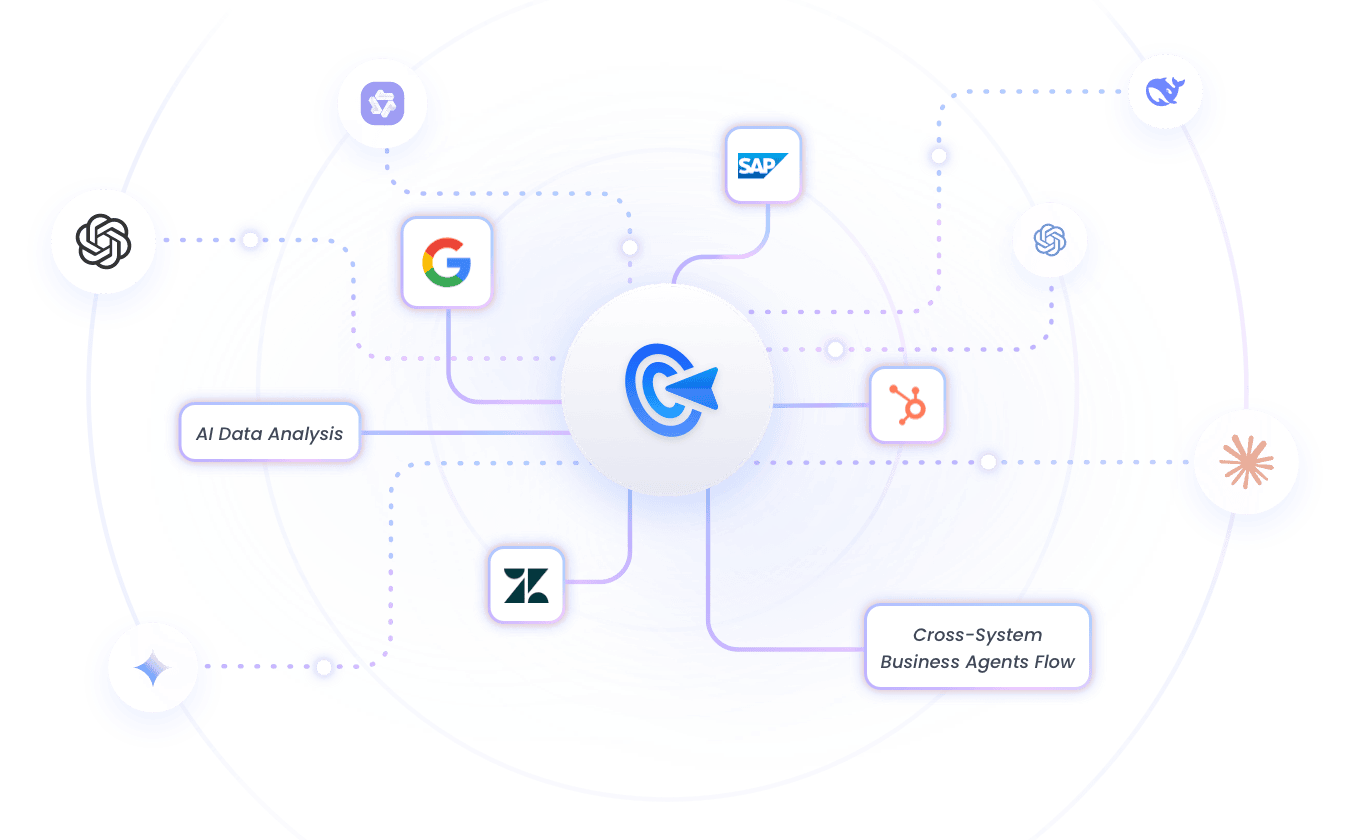
GoInsight.AI enables teams to share workflows and GoInsight Workspaces seamlessly across departments, breaking down data silos and tool fragmentation by integrating the following features:
| Key GoInsight Support Functions | Core Value and Implementation |
|---|---|
| Scaling Unstructured Data Analysis | Consolidating diverse unstructured data (interviews, social media, CRM logs, etc.) into a unified database. Advanced NLP extracts themes, sentiment, and behavioral signals, rapidly surfacing insights that would otherwise remain hidden. |
| Automated Data Cleaning and Standardized Report Generation | Through customized workflows or agents, it can detect anomalies and standardize formats, and eliminate time-intensive manual work. This frees users to focus on interpretation, boosting speed and efficiency. |
| From Descriptive to Predictive Analysis | Applying deep-learning models evolves analysis from merely describing "what happened" to explaining "why" and predicting "what will happen." This empowers marketers to trace causal links and forecast behaviors, allowing for proactive anticipation instead of reaction. |
| Zero-Cost, High-Efficiency Virtual Testing | Through customized workflows or agents, it supports creating synthetic personas, enabling research teams to test messages and scenarios in a simulated environment prior to live engagement; this dramatically reduces costs, speed of iteration, and risks of live testing. |
Conclusion
Generative AI is redefining market research, accelerating data analysis and generating predictive, actionable insights.
However, its full potential still depends on bridging human expertise with intelligent systems to ensure accuracy, reliability, and transparency. GoInsight.ai embodies this balance, turning fragmented workflows into a continuous, insight-driven intelligence engine.
Ultimately, the future of market research will belong to organizations that effectively merge automation with human interpretation.
FAQs about AI in Market Research



Leave a Reply.