

- What Is AI for Financial Analysis?
- Core Use Cases of AI in Financial Analysis
- 1. Daily Financial & Market Briefing
- 2. Budget vs Actual Analysis
- 3. KPI & Performance Monitoring
- 4. Forecasting & Scenario Analysis
- 5. Risk & Compliance Monitoring
- Challenges of Applying AI in Financial Analysis
- Bringing AI into Real-World Financial Analysis
- Conclusion
- FAQs
Data volume, reporting frequency, and decision pressure are increasing among finance professionals, leaving 93% of financial teams struggling with poor data handling. This is painfully obvious to most enterprise leaders as their financial analysts spend 45% of their time collecting and validating information instead of analyzing.
In the middle of all this, AI for financial analysis is no longer optional but essential for businesses to stay competitive.

What Is AI for Financial Analysis?
AI for financial analysis augments how teams analyze, interpret, and act on financial information. It encompasses continuous interpretation, anomaly explanation, performance monitoring, and proactive insight generation.
Some people might argue that using AI in financial analysis is limited to forecasting or modeling. However, AI has evolved far beyond basic automation and traditional business intelligence dashboards.
Beyond Static Reports and Manual Workflows
Not long ago, most teams worked in siloed models, juggling manual spreadsheet adjustments, static dashboards, and delayed commentary. Today’s advanced AI tools can learn from data, interpret context, explain patterns, monitor changes, and generate insights that humans alone cannot keep up with.
Unlike static business intelligence and historical snapshots, AI financial analysis operates in near real time. This allows leaders to base decisions on live data rather than delayed reports. Traditional BI answers “what happened.” AI for financial analysis goes further—explaining “why it happened” and even suggesting “what might happen next.”
This shift transforms the finance function from a producer of reports into a provider of decision-ready intelligence.
Core Use Cases of AI in Financial Analysis
To most people, the benefits of AI-powered financial analysis are clear. The difficulty lies in visualizing its practical, day-to-day application. Here are five core use cases where AI financial analysis delivers tangible results.
1. Daily Financial & Market Briefing
Current Challenges
CFOs, FP&A teams, and investment analysts receive vast streams of financial news and market data daily with no reliable way to assess impact quickly. They end up desperately trying to skim headlines instead of understanding relevance.
Also, manually sifting through and digesting large data volumes, news, and updates is painfully slow and inconsistent. More often than not, financial teams miss critical signals in the data scope and frequency.
How AI Solves It
AI automatically aggregates financial news, market movements, and internal signals to deliver concise summaries with risks and opportunities highlighted. Instead of sifting through hundreds of sources, teams receive digestible, impact-oriented insights.
The AI financial analysis workstream filters noise to provide a concise briefing on relevant developments, connecting external events to company-wide KPIs.
2. Budget vs Actual Analysis & Variance Explanation
Current Challenges
After month-end closes, the real work begins: explaining why actuals deviated from the budget. While the math is straightforward, explaining why variances occurred is slow and repetitive. Teams dig through spreadsheets, chase down department leads, and spend hours building narratives that often lack depth. The process is manual and reactive.
How AI Solves It
AI for financial analysis automatically identifies significant variances, flags unusual patterns, correlates them with operational data (e.g., sales volume, headcount changes, campaign dates), and generates initial explanatory commentary.
The moment teams realize the AI has drafted the first pass of the variance report, the analysis shifts from data assembly to insight validation. This reclaims valuable time for finance to investigate root causes, explain variance, and recommend corrective actions.
3. KPI & Performance Monitoring
Current Challenges
Enterprises track dozens, if not hundreds, of KPIs. The challenge? While many KPIs update frequently, human monitoring doesn’t. A deviation might go unnoticed for days until the next scheduled review. Somehow, the assumption is that someone is always watching, and leadership often gets a static snapshot without context.
How AI Solves It
AI continuously watches key metrics, detects anomalies, automatically interprets changes, and sends real-time alerts to relevant stakeholders with contextual interpretation. This workflow creates a sense of momentum as finance leaders receive timely, decision-ready intelligence without logging into another system.
Example, “Sales dropped 12% in Region X. This coincides with a supply chain delay flagged in procurement logs.”
4. Forecasting & Scenario Analysis
Current Challenges
Management frequently asks, “What if X happens?” Examples: "What will happen if interest rates rise by 50 basis points?" or "What is the impact of a 10% raw material cost shock?" Traditional methods require manual adjustments and reruns, consuming days or weeks. Plus, manually rebuilding models for each new scenario is often inconsistent.
How AI Solves It
AI financial analysis enables rapid scenario testing. Machine learning models ingest historical and real-time data to simulate outcomes under varying assumptions. More importantly, they explain the drivers behind each projection. As a result, finance teams can confidently present forecasting and scenario analysis to top management and enable better strategic planning.
5. Risk & Compliance Monitoring
Current Challenges
Many financial risks emerge from overlooked patterns, not intentional oversights. Security and compliance breaches, a problematic clause in a new contract, liquidity shortfalls, or exposure concentration often hide in plain sight across siloed systems. At the same time, compliance teams struggle with ever-changing rules and massive datasets.
How AI Solves It
AI for financial analysis proactively scans both structured and unstructured data. It extracts early-warning signals, such as irregularities, potential market abuse, and regulatory discrepancies, before they escalate.
In many ways, the predictive and pattern-detection capabilities of AI act as an early warning system. This is something no manual process can match consistently.
Challenges of Applying AI in Financial Analysis
The potential is clear. Even so, deploying AI in actual financial organizations presents real hurdles. What issues arise in practice?
1. Fragmented Data and Systems
Fragmented data and systems across ERPs, CRMs, and spreadsheets create a foundational barrier. AI models require clean, integrated data feeds, which is rarely the default state. Hence, data preparation often becomes the bottleneck.
2. Non-scalable Workflows
Many organizations treat AI initiatives as a one-off analysis or an experiment. Think impressive proofs of concept that never become repeatable, scaled processes. They lack integration into daily workflows.
3. Limited Governance and Traceability
There is a frequent lack of governance and auditability. How did the AI arrive at that conclusion? Can its logic be traced? For regulated finance functions, this is a non-negotiable requirement.
4. High Maintenance Overhead
Early AI workflows often require high manual effort to maintain, curate data, and validate outputs, negating the promised efficiency. This is the part no one talks about: without a sustainable operating model, using AI in financial analysis projects falters.
5. Talent and Skill Gaps
Many finance teams lack staff with both domain expertise and AI/data science skills. Without the right people to design, monitor, and interpret models, AI risks being underutilized, misapplied, or producing misleading insights.
Bringing AI into Real-World Financial Analysis with GoInsight.AI
To move beyond prototypes, companies need a framework that addresses the core challenges. This includes:
- Unified Data, Systems, and Tools: A cohesive layer to connect disparate sources, from ERPs and CRMs to market data feeds.
- AI-to-Human Handoff & Actionability: A reliable system will facilitate seamless transition from AI-generated insight to human review, decision, and action with clear next steps.
- Cross-Team Collaboration: The lack of centralized workspaces makes it difficult for teams to share AI-driven insights with other departments. Without a unified platform, communication gaps may lead to delays in decision-making and action.
- Enterprise Governance & Visibility: Full audit trails, version control, and performance tracking of AI-driven analyses are keys for governance and visibility.
How GoInsight.AI Enables AI-Driven Financial Analysis at Scale
GoInsight.AI transforms the value of AI in financial analysis, as discussed in the use cases above, from isolated experiments into repeatable, collaborative, and governable workflows. It embeds AI directly into a company’s day-to-day financial analysis operations.
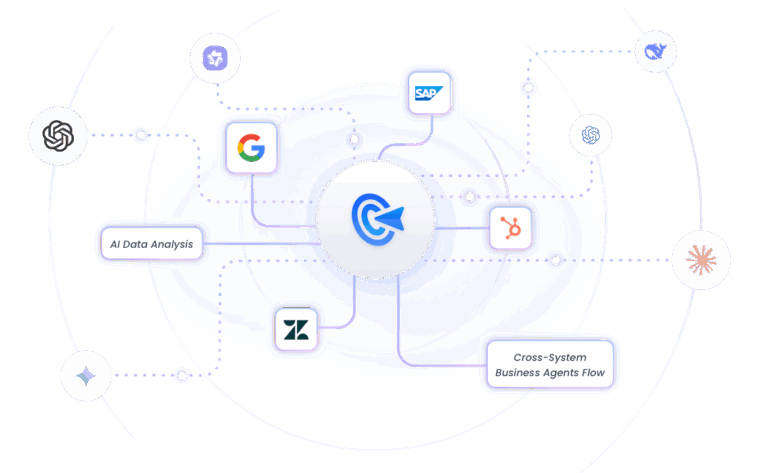
Key Features:
- Automation & Integration: Connects diverse systems and applications, automating data aggregation that is so often the initial bottleneck.
- Unified Collaboration Workspace: This feature shifts financial analysis from an individual, desktop activity to a team-based discipline. Teams can share, debate, and iterate upon analysis in a single environment.
- Governance & Measurability: Logs every step for performance tracking, regulatory oversight, and accountability. This elevates AI analysis from trial-and-error experimentation to a sustainable, measurable corporate investment.
GoInsight.AI enables finance teams to leverage AI-driven financial analysis through the automation of data workflows and insights across systems. The flexible architecture makes it highly scalable for growing use cases while providing measurable outcomes.
Ready to turn AI for Financial Analysis into real operational impact?
See how GoInsight.AI helps enterprises automate financial workflows at scale.
Conclusion
The value of AI for financial analysis lies not in its novelty or theoretical potential but in its operational integration. At a time when data grows faster than decision cycles, the shift from manual, reactive analysis toward continuous, decision-ready intelligence provides a strategic advantage.
Financial analysis, as we know it, is evolving into an always-on, AI-augmented capability. Organizations that successfully operationalize AI will gain a structural advantage in the speed and quality of their decision-making.
FAQs



Leave a Reply.