

- What Is AI Customer Feedback Analysis
- Key Use Cases of AI Customer Feedback Analysis
- Challenges of AI-Powered Customer Feedback Analysis
- Operationalizing Customer Feedback Analysis with GoInsight.AI
- Example: Automating Customer Feedback Analysis with an AI Workflow
- Emerging Trends in AI Customer Feedback Analysis
- Final Words
- FAQs
Every day, enterprise customer service teams are flooded with hundreds of survey responses, tickets, chat logs, and social media mentions. Manually categorizing this avalanche of feedback eats up hours—and critical issues can slip through unnoticed, sometimes until a customer posts publicly.
Traditional methods have hit a wall. Slow, inconsistent, and error-prone, manual customer feedback review can’t keep up. That’s why more businesses are turning to AI customer feedback analysis. Research shows 56% of companies are already using AI in customer service, and 37% of all customer interactions are expected to involve some form of AI.
From exploring key use cases and common challenges to showcasing real-world workflows, this article highlights how AI is transforming the way enterprises analyze and act on customer feedback.
What Is AI Customer Feedback Analysis
AI Customer Feedback Analysis refers to the use of artificial intelligence, particularly natural language processing (NLP) and machine learning, to automatically process and analyze customer feedback from various sources such as surveys, reviews, social media, and support tickets. By leveraging these technologies, AI can efficiently extract valuable insights from unstructured data, enabling businesses to understand customer sentiment, identify recurring issues, and make data-driven decisions.
Benefits of Using AI in Customer Feedback Analysis
- Faster Analysis: AI can process large volumes of feedback in a fraction of the time it would take manually, allowing businesses to act on insights quickly.
- Improved Accuracy: Through sentiment analysis, AI can accurately detect customer emotions, such as frustration or satisfaction, with high precision.
- Real-Time Feedback Monitoring: AI systems can continuously monitor feedback as it comes in, enabling businesses to address issues as they arise and improve customer satisfaction.
- Data-Driven Insights: AI enables businesses to uncover hidden patterns and trends in feedback data, providing actionable insights that inform product development, marketing strategies, and customer support improvements.
- Operational Efficiency: By automating the feedback analysis process, AI reduces the need for manual intervention, cutting down on labor costs and human error while increasing efficiency.
A quantitative study found that 93% of firms use AI, especially in customer service, forecasting, and decision support. The majority of the enterprises agreed that AI systems increase the speed and clarity of managerial decisions. With that in mind, AI for customer feedback analysis is crucial, as it allows faster decision-making and improves customer experience.
Key Use Cases of AI Customer Feedback Analysis
AI-powered customer feedback analysis can support a wide range of business functions by transforming large volumes of unstructured feedback into actionable insights. Below are several common use cases where AI delivers significant value.
1. Product Improvement
Customer feedback often contains valuable insights about product usability, missing features, and recurring issues. AI can analyze feedback to identify patterns and highlight the most frequently mentioned problems or feature requests. This enables product teams to prioritize improvements based on real user needs rather than assumptions.
2. Customer Support Optimization
AI can help support teams respond more efficiently by automatically detecting negative sentiment or urgent complaints. Feedback that indicates frustration or dissatisfaction can be flagged and routed to support agents for faster resolution. This ensures that critical issues receive immediate attention and helps reduce response times.
3. Brand Sentiment Monitoring
Businesses often receive feedback across multiple public channels such as app stores, social media, and review platforms. AI can continuously analyze these conversations to track overall brand sentiment and identify sudden shifts in customer perception. This helps companies quickly detect potential reputation risks and respond proactively.
4. Market and Customer Insights
Beyond operational improvements, AI feedback analysis can reveal deeper insights about customer expectations, preferences, and emerging trends. By analyzing large datasets of customer comments, organizations can uncover patterns that inform marketing strategies, product positioning, and future innovation.
Challenges of AI-Powered Customer Feedback Analysis
While AI customer feedback analytics tools are great, they come with their own set of limitations. We’ve explained the common ones below:
Data Quality
The accuracy of AI outputs depends on data quality and model training. If the training data is not clean or representative enough, the model will give flawed or questionable insights. Plus, models trained on limited datasets miss the broader context.
Complex Context Understanding
AI may struggle with sarcasm and cultural context. A sentence may appear positive but carry negative intent. For example, a customer writes: “Great, another update that broke everything.” A basic sentiment model might read “great” as positive.
Cross-System Integration
AI-based feedback analysis does not operate in isolation. It needs to connect to CRMs, ticketing systems, and data warehouses for optimal performance. Legacy platforms may not support real-time data flow. That said, integration timelines and challenges decrease with modern architectures and APIs.
Human Oversight Still Matters
Human supervision is still crucial. AI can highlight trends and insights, but humans are still necessary to guide decision-making. The most effective implementations pair algorithmic analysis with experienced reviewer validation.
Operationalizing Customer Feedback Analysis with GoInsight.AI
To address the challenges mentioned above, organizations need more than just AI models—they need a system that can connect data sources, automate analysis, and turn insights into action. Platforms like GoInsight.AI help operationalize AI-powered customer feedback analysis through automated workflows and intelligent agents.
Key capabilities include:
- Visual Workflow Builder: Teams can design and modify AI workflows using a low-code visual interface, making it easy to adapt feedback analysis processes as business needs evolve.
- Cross-System Integration: Connects feedback sources such as CRM systems, ticketing tools, surveys, and review platforms, enabling organizations to analyze feedback from multiple channels within a unified workflow.
- Knowledge Bases & RAG: By connecting internal documentation, product knowledge bases, and historical feedback data, GoInsight.AI can use RAG to provide more context-aware analysis and recommendations.
- Human-AI Collaboration: When feedback requires careful handling, teams can review or approve AI outputs through Human-in-the-Loop steps, ensuring accuracy and maintaining control over important decisions.
Example: Automating Customer Feedback Analysis with an AI Workflow
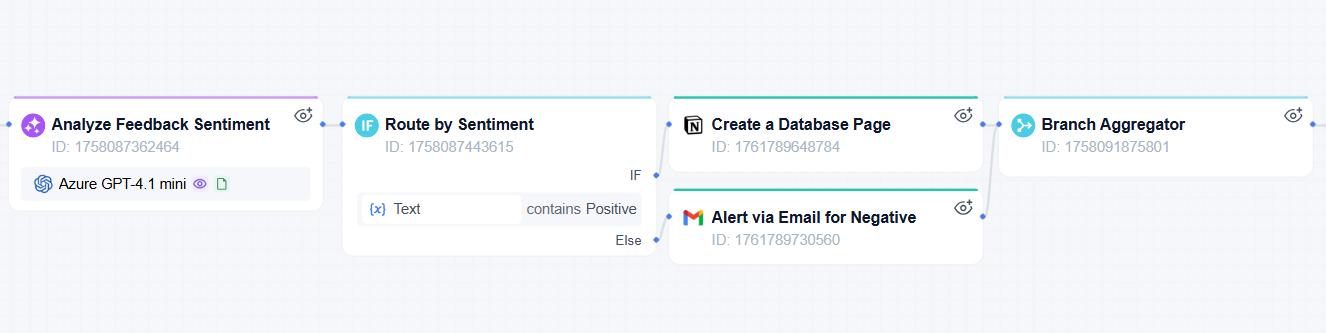
One example is the Feedback Analysis and Routing Assistant, a workflow designed to automatically analyze and route incoming customer feedback. The workflow operates through several automated steps:
- Feedback Collection
- The workflow first pulls customer feedback from connected systems such as review platforms, support tickets, surveys, or CRM records through GoInsight.AI’s integration capabilities.
- AI Sentiment Analysis
- The assistant then uses an LLM node to evaluate the sentiment of each feedback entry, automatically determining whether the message expresses positive or negative sentiment.
- Feedback Classification
- Based on the analysis results, the workflow categorizes feedback into relevant types—such as praise, complaints, or feature suggestions—making it easier for teams to understand the nature of the feedback.
- Automated Routing
- The workflow then triggers predefined actions. Positive feedback can be archived or shared internally with teams, while negative feedback is automatically routed to the appropriate department for timely follow-up.
This workflow can be easily customized to fit different feedback channels, business rules, and team structures.
Through workflows like this, organizations can transform scattered feedback into structured insights and actionable tasks—making customer feedback analysis faster, more scalable, and easier to operationalize.
Emerging Trends in AI Customer Feedback Analysis
AI-powered customer feedback analysis is evolving rapidly, moving far beyond simple keyword detection. Several emerging trends show how enterprises are using AI to extract deeper insights and respond to customer signals faster.
AI Agents for CX Insights
AI agents are emerging as a new layer of automation for customer feedback analysis. These agents can continuously monitor feedback streams, summarize insights, detect trends, and recommend actions. In some cases, they can even trigger follow-up surveys or questions, turning feedback analysis into a continuous and partially autonomous process.
Unsupervised AI Discovering Hidden Insights
Customer experience teams are increasingly using unsupervised AI to uncover patterns, themes, and anomalies directly from unstructured feedback such as surveys, support tickets, and product reviews. By identifying recurring topics and unexpected signals automatically, these systems help teams detect emerging issues earlier and understand customer concerns at scale.
Multimodal Feedback Analysis
Customer feedback today extends beyond written text to include voice recordings, video testimonials, and other media. AI systems are increasingly able to analyze multiple formats simultaneously. For example, using voice sentiment analysis to capture tone and emotional cues, allowing enterprises to build a more complete picture of customer sentiment across channels.
Real-time Customer Intelligence
Traditional feedback analysis often relies on periodic reports, which can delay important insights. AI is enabling real-time monitoring through dashboards that update as feedback arrives, allowing companies to quickly detect shifts in customer sentiment and adjust messaging, product priorities, or support strategies.
Final Words
AI Customer Feedback Analysis is transforming how organizations understand and respond to customer voices. By leveraging AI to process large volumes of feedback, businesses can quickly uncover sentiment, identify recurring issues, and take timely action. However, turning insights into real operational workflows requires the right tools. Platforms like GoInsight.AI help organizations automate feedback analysis, streamline routing, and ensure that customer insights lead to meaningful improvements.
FAQs



Leave a Reply.