

- What Is The Peak Season Gap?
- Why Traditional Capacity Planning Breaks during Peak Season
- 1. The Timing Penalty
- 2. The Single-Number Trap
- 3. The Missing Contingency
- What AI-Powered Capacity Planning Should Actually Help You Decide
- A Real Logistics Example: Yokogawa + Hokuetsu Logistics
- What This Means For Your Operations
- How GoInsight.AI Brings AI Capacity Planning into Practice
- How to Get Started
- FAQs
- In logistics, AI capacity planning is less about finding one perfect number and more about making better decisions on capacity, timing, and contingency.
- Peak-season planning rarely breaks because teams lack a forecast. It breaks because a forecast alone does not tell you what to do next.
- A useful planning system should do more than predict demand. It should show where the number comes from, how much uncertainty sits behind it, and what actions make sense if reality shifts.
- The real risk usually shows up in three places: committing too late, trusting a single number too much, and having no clear backup plan when conditions change.
- For any of that to matter in practice, those outputs need to feed into real workflows—not just sit in a dashboard.
Imagine you're a fleet manager. It's mid-October, less than a month before Black Friday. Your peak-season forecast says you'll need 235 trucks for Black Friday week. You have 180. The remaining 55 need to be rented, but rental rates double in November.
A forecasting tool might tell you: "You need 55 trucks." Then stop.
But here's what it won't answer:
- Where did that 55 come from?
- Can I trust it enough to commit the budget now?
- What if demand spikes 20% higher?
This is the gap between a prediction and a plan.
In logistics, AI capacity planning uses AI to turn forecasts into decisions about capacity, timing, and contingency. It does not chase a perfect number, but rather makes time‑sensitive, risk‑aware choices under uncertainty.
Descartes's 2025 report shows 96% of logistics providers already use gen AI. But the real struggle is rarely getting a forecast. Leaders have forecasts and spreadsheets. What they often lack is a way to turn that number into actions they can actually execute under peak‑season pressure
So what if the goal isn't a perfect prediction, but a capacity plan that still works when reality changes? This article looks at why traditional planning breaks down during peak season and what a working AI-powered capacity plan looks like in action.
What Is The Peak Season Gap?
If you manage logistics during peak season, this probably feels familiar. You have a forecast. You compare it against your fleet and identify a shortfall. On paper, everything looks under control. But when peak season arrives, things rarely unfold exactly as forecast.
This is what I mean by the Peak Season Gap.
It's not a shortage of trucks or a bad forecast. It's the gap between knowing what might happen and knowing what to do when it does. Most teams don't struggle to get a number; they struggle to turn that number into an actionable plan.

In fact, this gap shows up when teams have a forecast but no pre-agreed playbook for acting on it.
To see whether you are operating in that gap, ask yourself:
- If peak season demand turns out to be 20% higher than forecast, could you say today what you would do differently?
- Do you have pre-set trigger conditions, such as "when inventory exceeds X, activate backup capacity?"
- If your preferred rental company has no vehicles available, do you know your second and third options and their costs?
If you had to pause on any of these, you're not alone. But it also means there's a gap between your forecast and your execution, and that gap often shows up later as premium rentals, rushed decisions, and avoidable service risk.
Why Traditional Capacity Planning Breaks during Peak Season
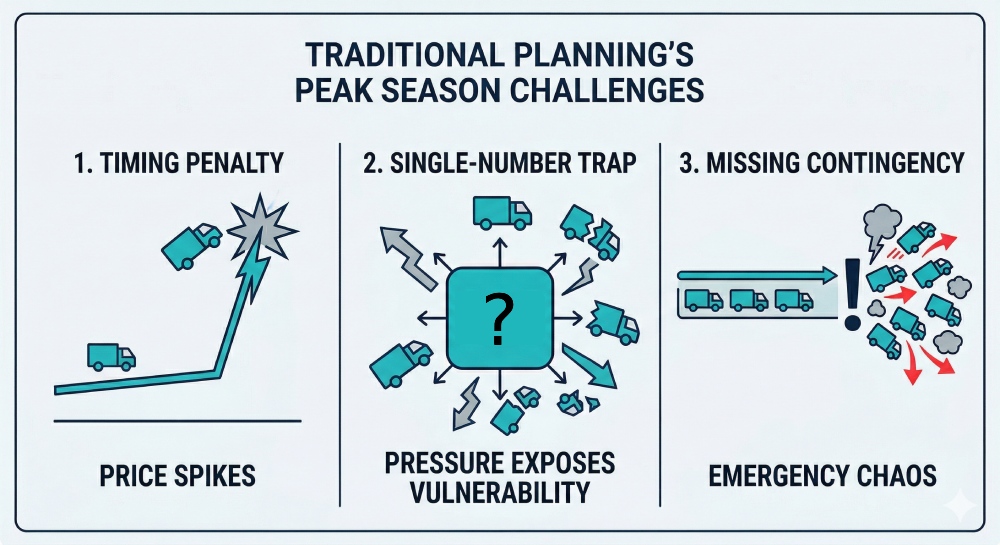
Most logistics teams already have a capacity planning process. It usually looks like this: use last year's data, apply a growth factor, compare against current fleet capacity, then secure extra trucks a few weeks before peak season.
It works. It's structured and repeatable. In stable environments, it can be good enough. But peak season puts pressure on exactly the assumptions that make this approach feel safe.
Three problems tend to show up.
1. The Timing Penalty
Rental pricing doesn't always rise gradually. In peak periods, it can spike.
A truck that is relatively affordable in August may cost dramatically more by November. By the time many teams finalize their forecast (often just 2-4 weeks before peak season), they're no longer choosing from a full market. They're just taking what's left.
At that point, you're not really planning ahead, you're paying the leftover price.
2. The Single-Number Trap
Traditional planning often revolves around a single number: you need 235 trucks. That becomes the plan.
But a single number hides the uncertainty behind it. Demand shifts, driver availability changes, and some routes are more volatile than others.
Under peak-season pressure, "235" is not always a plan. Sometimes it is just a bet with no visibility into the downside.
3. The Missing Contingency
Most plans stop at the expected scenario. There's no clear answer for sudden situations like: what if demand is higher? what if capacity drops? What if a supplier falls through?
When that happens, teams move into firefighting mode, like scrambling for last-minute rentals, rerouting shipments, or bsorbing delays. And firefighting is almost always more expensive than planning.
Where Traditional Planning Creates Hidden Costs
| Traditional Step | What It Looks Like | Hidden Cost |
|---|---|---|
| Use last year's data + growth factor | Generate a single demand estimate | Ignores uncertainty and route-level variability |
| Compare against current fleet | Identify capacity shortfall | Assumes actual conditions will closely match the forecast |
| Rent trucks 2-4 weeks before peak season | Secure remaining capacity | Locks in higher prices and fewer choices |
| React during peak season | Adjust in real time | Leads to costly, last-minute decisions |
But the reality is, none of this comes down to a lack of experience or effort. In many cases, this is not a skill problem. It is a planning, tooling, and workflow problem.
What AI-Powered Capacity Planning Should Actually Help You Decide
This is where AI-powered capacity planning begins to differ from forecasting alone. As we said before, the goal here is not just to generate a number; it's to help teams make better decisions about capacity, timing, and contingency before peak-season pressure forces reactive choices.
That difference shows up in three questions we raised in the introduction, questions that most teams still can't confidently answer.
- Where did that number come from?
- Can I trust it enough to commit the budget now?
- What happens if reality doesn't match the forecast?
Q.1 Where did that "55" come from?
A good AI-powered capacity planning system should be able to show how that number was built. That usually means pulling from multiple layers of operational data: route-level shipment volumes from previous peak periods, current fleet size, maintenance schedules, driver availability, utilization patterns, and historical rental pricing.
The system should not simply apply the growth factor to last year's total. It should be able to identify where demand behaves differently across routes, time windows, or regions.
For example, it may detect that Route A consistently sees a sharp volume spike in the three weeks before Black Friday, while Route B stays relatively stable. That difference matters because it changes not only how much capacity you need but where you need it.
Q.2 Can I trust it enough to commit the budget now?
A single-number estimate can look precise while hiding a lot of uncertainty. A stronger system should give planners a range. For example, 45 to 65 additional vehicles, along with a clear explanation for this uncertainty.
That uncertainty may come from route-level demand volatility, inconsistent driver availability, or changes in rental supply. Don't hide uncertainty. Make it visible so that planners will know how to handle it. In this sense, trust does not come from a more confident-looking number. It comes from understanding the range, the assumptions behind it, and the level of risk attached to each decision.
Q.3 What if demand spikes 20% higher?
Instead of waiting for the scenario to happen, the AI plans for it in advance. It automatically runs alternative scenarios, such as demand increasing or decreasing by 20%, and generates corresponding action plans. These include how many additional vehicles to secure, what portion should be refundable, the expected cost impact, and when to activate those decisions.
It also defines trigger conditions. For example, if order volume exceeds a specified threshold or if utilization crosses a set limit, the system flags it and initiates the next step. It's not hoping to perfectly predict one future, but rather to prepare for multiple plausible futures before peak season arrives.
💡Of course, none of this works well without the right operating inputs. Range estimates, trigger conditions, and scenario plans all depend on data quality, update frequency, and agreement across teams on what action should follow.
Why a Workflow Layer Matters
Even if a planning system can produce a range, a confidence view, and a contingency playbook, that still does not guarantee action. Someone still needs to connect the data, trigger the model at the right time, route the output to the right people, and turn the recommendation into an actual operational step.
That's why a workflow layer matters. This layer needs to do four things well:
- connect data from systems such as TMS, fleet management, HR, and procurement
- trigger the right models or rules at the right planning interval
- route outputs into actions, such as alerts, approvals, or rental requests
- keep humans in the loop for high-stakes decisions
Without that layer, even a strong forecast can still die in a spreadsheet, a dashboard, or an email thread.
For example: When the AI detects a potential 20% demand spike scenario, the workflow layer could automatically alert procurement, attach the forecast range, and wait for a manager’s approval before contacting rental partners. That turns a scenario output into a concrete action without manual intervention.
A Real Logistics Example: Yokogawa + Hokuetsu Logistics
Hokuetsu Logistics in Japan faced a planning challenge common in logistics: too many constraints, too much manual coordination, and too much reliance on experienced specialists. Its loading plans had to account for product shape, vehicle type, delivery requirements, and other operational constraints, which made planning harder to scale.
Working with Yokogawa's team, Hokuetsu developed an AI system that could replicate planner decision logic and automatically generate loading plans using existing operational data.
Inputs included:
- Shipment information
- Vehicle information
- Delivery requirements
- Planner-defined constraints
The outcome:
- Loading plans were generated in under 10 seconds
- Planning quality was maintained while planning time was reduced
- Operational burden on specialists was lowered
This case shows a core principle behind AI capacity planning: it's not just about a simple number or analysis, but about turning operational complexity into a plan that teams can actually execute.
While this is not a Black Friday fleet-rental example, it illustrates a related point: AI becomes valuable when logistics planning must translate multiple operational constraints into fast, executable decisions.
What This Means For Your Operations
You do not need perfect data or a full system overhaul to get started. But you do need to shift how you think about planning. A few simple rules can help:
1. Start with existing data
In many cases, 2-3 years of shipment history, fleet logs, and rental records are enough to build a more useful planning view.
2. Ask for ranges, not single numbers
If your system only gives you one answer, it may be hiding the uncertainty you most need to plan around.
3. Build contingency into your plans
Define how your team should respond to scenarios such as higher-than-expected demand or sudden capacity loss before those situations happen.
4. Use AI to automate routine, not replace the expert
Use AI-powered tools to automate routine work, not replace experts, so your team can focus on the decisions that require judgment.
5. Pilot on one route, or warehouse first
Start small in a place where volatility is high enough to matter and where the team can actually learn from the result.
How GoInsight.AI Brings AI Capacity Planning into Practice
As we've discussed earlier, the workflow layer is important. This is the point where a platform like GoInsight.AI can help.
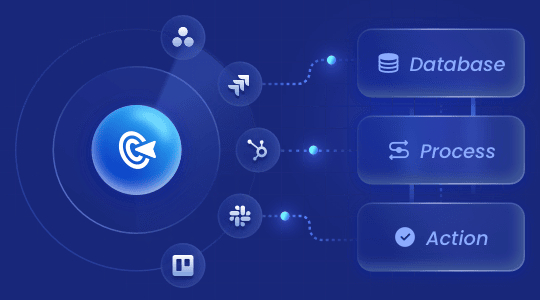
GoInsight.AI is built for this exact purpose. It's an AI-powered automation and collaboration workbench that lets you:
- Connect your data sources, such as pull route-level shipment history from your TMS, driver availability from your HR system, and real-time rental rates from external APIs.
- Run forecasts and scenario checks on schedule, so outputs feed directly back into the planning workflow instead of sitting in a separate dashboard.
- Route shortfall signals into action, such as notifying procurement or creating a rental request in an ERP system with a human approval step built in.
- Keep teams aligned on one operating view, so operations, procurement, and leadership work from the same assumptions, thresholds, and contingency triggers.
In other words, GoInsight.AI is not just about producing a forecast. It helps teams move from data to decision to execution in a more controlled way.
How to Get Started
Getting started with AI-powered capacity planning doesn't require a full system overhaul. In most cases, a focused pilot is the better starting point.
Step 1: Audit your data. Review route-level shipment history, fleet utilization, driver availability, and rental usage from the last few peak periods.
Step 2: Define your gap. Be specific. Is the problem peak-season demand volatility, delayed rental decisions, route-level imbalance, or a lack of contingency triggers?
Step 3: Run a pilot. Start with one route, lane, or warehouse where demand volatility is meaningful and results can be measured clearly.
Step 4: Build your contingency playbook. Model a few scenarios, such as demand at -20%, expected, and +20%, and define what action should follow each one.
AI-powered capacity planning has never really been about getting the number exactly right. It is about being prepared when reality does not follow the expected path. AI does not remove uncertainty, but it can help teams plan for it in a more structured way. This way, peak season becomes something you manage, not react to.
Struggling to turn static forecasts into a dynamic plan?
See how GoInsight.AI automates AI capacity planning and workflows to bridge the gap between data and action.
FAQs

For example, traditional forecasting gives you a single number like "you'll need 55 trucks." AI capacity planning not only tells you the number but also tells you where that number came from, how much uncertainty is behind it, and what to do if demand comes in higher or lower than expected.


Leave a Reply.